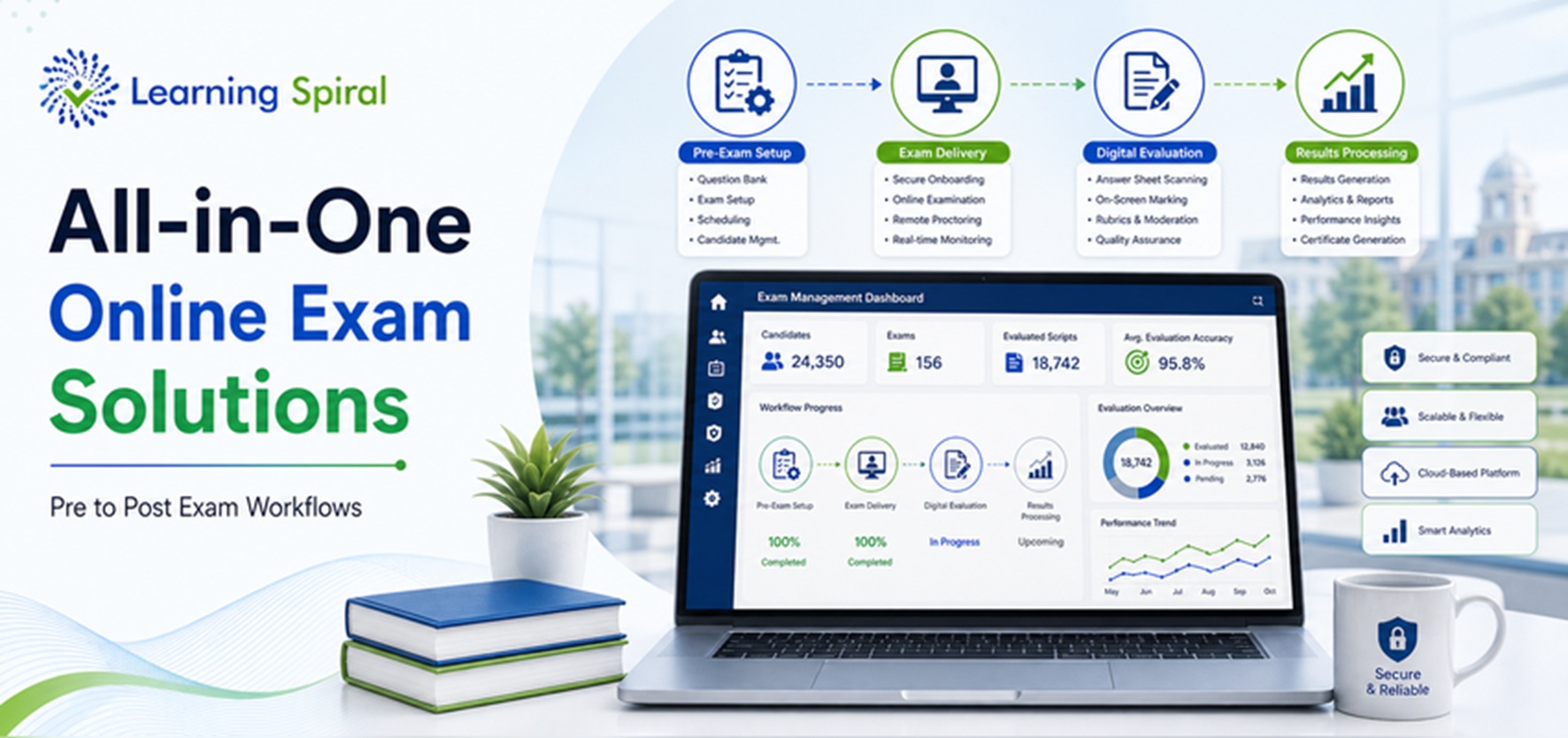
An All-in-One Online Exam Solution can transform the way universities, colleges, examination boards and educational institutions manage the complete examination lifecycle. Instead of relying on disconnected software, spreadsheets and manual workflows, institutions can bring Pre Examination Processing, Question Bank Management, Online Assessment, Answer booklet scanning, On Screen Evaluation, Digital Evaluation and Post Examination Processing into one connected ecosystem.
Conducting an examination may take only a few hours, but preparing for it, evaluating answer scripts and publishing accurate results can require weeks of coordinated work.
The real challenge is therefore not simply conducting an examination.
It is managing everything before, during and after the examination efficiently, securely and accurately.
This is where an integrated examination platform can make a major difference.
1. An All-in-One Online Exam Solution Simplifies Pre Examination Processing
A successful examination begins long before students enter the examination hall.
Pre Examination Processing involves several important administrative and academic activities that must be completed accurately and on schedule.
These generally include:
• Student examination registration
• Eligibility verification
• Subject and course mapping
• Examination timetable creation
• Examination centre allocation
• Roll number generation
• Admit card or hall-ticket generation
• Question-paper preparation
• Examiner and evaluator allocation
• Candidate database management
When these processes are handled through different applications or spreadsheets, examination teams may spend considerable time transferring and validating data.
An All-in-One Online Exam Solution helps institutions connect these activities within a structured examination workflow.
For example, student information entered during registration can automatically become available for subject mapping, examination scheduling, admit-card preparation and later result processing.
This reduces repeated data entry while creating greater continuity throughout the examination lifecycle.
Why efficient Pre Examination Processing matters
A streamlined pre-examination environment can help institutions:
• Reduce repetitive administrative work
• Maintain structured student and subject records
• Improve examination scheduling
• Reduce inconsistencies between departments
• Create better visibility for examination administrators
• Prepare examination data for subsequent evaluation and result processing
A strong University Management System should therefore connect academic information with examination operations instead of treating examinations as a completely separate activity.
2. Secure Question Bank Management Strengthens Examination Preparation
Question-paper preparation is among the most sensitive stages of an examination.
Traditional workflows may involve questions being shared through emails, documents, removable storage devices or manually maintained files.
This can make version control, authorization and confidentiality more difficult to manage.
A centralized Question Bank Management system provides a more structured approach.
Questions can be organized according to parameters such as:
• Subject
• Chapter or unit
• Difficulty level
• Marks
• Question type
• Learning objective
• Academic programme
• Examination pattern
Authorized faculty members can create, review and approve questions using defined workflows.
This can make question-paper generation more controlled while helping institutions maintain a reusable academic question repository.
Important advantages of Question Bank Management
1. Better organization:
Questions can be classified systematically.
2. Controlled access:
Access can be limited according to institutional roles.
3. Improved traceability:
Activities such as creation, review and approval can be digitally recorded.
4. Faster paper preparation:
Approved question repositories can simplify future examination cycles.
5. Better academic consistency:
Questions can be mapped against predefined academic requirements.
An All-in-One Online Exam Solution becomes particularly valuable when Question Bank Management is connected directly with examination scheduling and assessment delivery.
3. An All-in-One Online Exam Solution Makes Online Assessment Easier to Manage
Digital examinations require more than displaying questions on a computer screen.
A modern Online Examination System may need to support candidate authentication, examination scheduling, controlled access, timing rules, answer submission and examination monitoring.
Similarly, Online Assessment can include different forms of technology-enabled testing and evaluation.
For institutions, the most important consideration is how these activities connect with the larger Examination Processing workflow.
An integrated Online Examination System can help connect:
• Candidate information
• Examination schedules
• Subject allocation
• Assessment configuration
• Examination responses
• Attendance records
• Evaluation data
• Result processing
Without integration, administrators may need to repeatedly export and import information between platforms.
An All-in-One Online Exam Solution reduces these operational gaps by creating continuity between pre-examination data and post-examination processes.
4. Answer Booklet Scanning Connects Paper Exams With Digital Evaluation
Universities do not necessarily need to replace handwritten examinations to gain the benefits of digital technology.
Traditional pen-and-paper examinations can still be conducted while the evaluation process becomes digital.
The bridge between these two environments is Answer booklet scanning.
After examination completion, physical answer scripts can be digitized through a structured Scanning of Answer Sheets workflow.
The scanning process should ensure that answer scripts are:
• Complete
• Clearly readable
• Correctly sequenced
• Properly mapped
• Securely stored
• Ready for evaluator allocation
Digital copies can then move into an On Screen Evaluation System, reducing the dependence on physical transportation of answer-script bundles.
Why Answer booklet scanning matters
Answer booklet scanning can help institutions:
1. Digitize physical answer scripts
2. Reduce physical movement of examination material
3. Improve script accessibility for authorized evaluators
4. Maintain structured digital records
5. Create the foundation for On-Screen Evaluation
When incorporated into an All-in-One Online Exam Solution, scanning becomes part of a continuous workflow rather than a separate administrative exercise.
5. An All-in-One Online Exam Solution Enables Smarter On Screen Evaluation
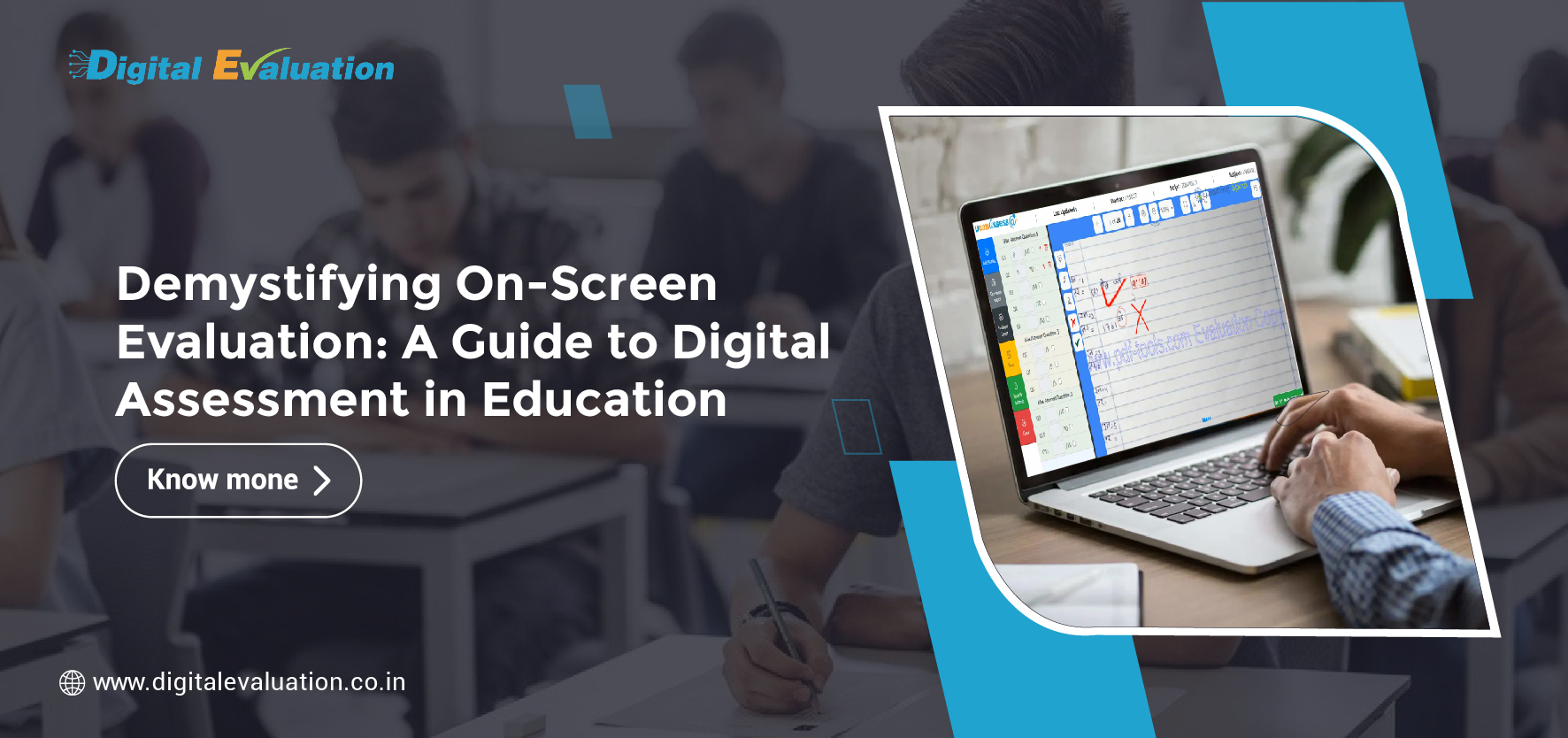
On Screen Evaluation allows evaluators to assess scanned answer booklets digitally rather than checking physical bundles of answer scripts.
In an On Screen Evaluation System, authorized evaluators can receive assigned scripts through a controlled digital interface.
The system can support activities such as:
• Evaluator allocation
• Script distribution
• Question-wise evaluation
• Marks entry
• Annotation
• Evaluation progress monitoring
• Script completion checks
• Moderation workflows
The term On-Screen Evaluation is also widely used to describe the same digital evaluation approach.
Some users may additionally search for an On- Screen Evaluation System, but the underlying objective remains the same: digitally manage the evaluation of handwritten answer scripts.
What changes for examination administrators?
Traditional evaluation often requires administrators to manually track physical answer-script bundles.
Digital evaluation can provide greater visibility into:
• How many scripts have been assigned
• How many scripts have been evaluated
• Which evaluators have pending work
• Which scripts require additional review
• How evaluation is progressing across subjects
This visibility can become particularly valuable for universities managing large-scale examinations.
6. On Screen Marking Makes Digital Evaluation More Structured
On Screen Marking is a central component of modern Digital Evaluation.
Through an On Screen Marking System, evaluators can access digitized answer scripts and enter marks directly within the evaluation platform.
An On-Screen Marking System can also apply predefined evaluation rules and validation controls.
For example:
• Maximum marks can be configured question-wise
• Unattempted questions can be identified
• Evaluators can add digital annotations
• Evaluation completion can be checked
• Selected scripts can be sent for moderation
• Progress can be monitored centrally
On-Screen Marking reduces the dependence on handwritten mark sheets and repeated manual marks entry.
Benefits of On Screen Marking
1. Structured evaluation
Evaluators follow a predefined digital marking workflow.
2. Greater visibility
Administrators can monitor evaluation progress.
3. Reduced physical handling
Answer booklets do not need to move repeatedly between locations.
4. Better workflow control
Scripts can be assigned according to defined institutional rules.
5. Digital auditability
Evaluation activities can be maintained within a structured digital environment.
An All-in-One Online Exam Solution can connect On Screen Marking directly with scanned answer scripts and subsequent result-processing workflows.
7. Digital Evaluation System Accelerates Post Examination Processing
The examination lifecycle does not end when evaluators finish checking answer scripts.
Universities still need to perform several important activities before results can be declared.
These may include:
• Marks compilation
• Verification
• Moderation
• Academic-rule application
• Result calculation
• Revaluation processing
• Scrutiny
• Result approval
• Result publication
A Digital Evaluation System can make these activities easier by creating a direct digital flow between evaluation and result processing.
Instead of repeatedly transferring marks from paper records to spreadsheets and then into result systems, evaluated marks can move into predefined workflows.
This can simplify Post Examination Processing considerably.
Digital Evaluation can help institutions achieve:
1. Faster movement of evaluated marks
2. Reduced repetitive data entry
3. Better visibility across evaluation stages
4. Structured moderation workflows
5. Easier retrieval during scrutiny or revaluation
6. Better coordination between evaluation and result teams
A connected Digital Evaluation System therefore does much more than simply digitize answer checking.
It helps connect evaluation with the larger examination ecosystem.
How an All-in-One Online Exam Solution Connects the Complete Examination Lifecycle
The biggest advantage of an All-in-One Online Exam Solution is integration.
A university should not need separate disconnected processes for every examination stage.
Ideally, the workflow should operate like this:
Step 1: Pre Examination Processing
Student records, subjects, schedules and examination requirements are prepared.
↓
Step 2: Question Bank Management
Questions are created, categorized, reviewed and approved.
↓
Step 3: Online Examination System or Written Examination
Students take the examination through the chosen mode.
↓
Step 4: Answer Booklet Scanning
Written answer scripts are converted into digital files.
↓
Step 5: On Screen Evaluation
Digital answer scripts are securely allocated to evaluators.
↓
Step 6: On Screen Marking
Evaluators assess responses and enter marks digitally.
↓
Step 7: Digital Evaluation
Evaluation, moderation and verification workflows are completed.
↓
Step 8: Post Examination Processing
Marks are processed according to institutional academic rules.
↓
Step 9: Result Publication
Approved examination results are prepared and released.
This connected journey can significantly reduce the fragmentation commonly seen in traditional examination operations.
Why Universities Need a Connected University Examination System
Managing thousands—or sometimes lakhs—of student examination records requires more than standalone software.
A modern University Examination System should connect examination administration, evaluation and result-processing activities.
The system should help authorized stakeholders answer important operational questions such as:
• How many students are registered?
• Which examination centres have been allocated?
• Have all question papers been prepared?
• How many answer booklets have been scanned?
• How many scripts have been evaluated?
• Which evaluators still have pending scripts?
• Which cases require moderation?
• Is result processing complete?
Having this information available within connected workflows can make examination management more transparent and manageable.
What Should Institutions Look for in an All-in-One Online Exam Solution?
Before selecting examination technology, universities should evaluate more than the feature list.
They should consider whether individual features actually work together.
Look for these seven capabilities:
1. Complete Pre Examination Processing
The platform should support candidate data, scheduling, examination configuration and related administrative workflows.
2. Secure Question Bank Management
Institutions should be able to create and manage structured question repositories.
3. Flexible Online Assessment
The solution should support technology-enabled assessment requirements where applicable.
4. Reliable Answer booklet scanning
Written examinations should be capable of entering the digital evaluation workflow.
5. Integrated On Screen Evaluation
Evaluators should be able to securely access assigned scripts digitally.
6. Structured Digital Evaluation
Marking, moderation and verification should work within a controlled workflow.
7. Complete Post Examination Processing
Evaluated marks should connect efficiently with result-processing activities.
The goal should not simply be having multiple modules.
The goal should be ensuring that those modules work together.
The Real Value of an All-in-One Online Exam Solution
Digital transformation is not about adding more software to the examination department.
It is about reducing unnecessary complexity.
An integrated examination ecosystem can help institutions move from:
• Disconnected systems → Connected workflows
• Physical answer-script movement → Digital Evaluation
• Manual bundle allocation → On Screen Evaluation
• Repetitive marks entry → Structured digital processing
• Isolated question files → Question Bank Management
• Fragmented result processing → Integrated Post Examination Processing
That is the real value of an All-in-One Online Exam Solution.
It connects individual examination processes into one coordinated workflow.
From Question Bank to Final Result: One Connected Examination Journey
Modern universities need examination systems that can evolve with increasing student volumes, complex academic structures and growing expectations for faster examination processing.
An integrated Online Exam Solution can support this transformation by connecting Pre Examination Processing, Question Bank Management, Online Assessment, Answer booklet scanning, On Screen Evaluation, On Screen Marking, Digital Evaluation and Post Examination Processing.
Learning Spiral Ltd. helps universities, educational institutions and examination bodies modernize examination operations through technology-driven examination solutions.
Instead of digitizing isolated processes, institutions can work toward a connected examination ecosystem where information moves smoothly from one stage to the next.
An All-in-One Online Exam Solution can help make that possible.
From the first question entered into the question bank to the final result delivered to the student, every stage can become part of one connected digital examination journey