
What if the biggest delay in university examination results is not the evaluation itself, but everything happening between collecting answer booklets and publishing grades?
Thousands of answer sheets, multiple evaluation centres, manual mark calculations, missing pages, and last-minute result corrections can turn every examination cycle into an operational challenge.
The solution is not simply replacing paper with screens. It is creating a connected, reliable, and transparent examination workflow.
A modern Digital Evaluation System connects answer booklet scanning, evaluator allocation, On-Screen Marking, quality assurance, and final result processing within a structured digital environment.
But how does an institution move from a handwritten answer booklet to a verified final grade without losing accuracy, confidentiality, or control?
Let’s explore the seven essential stages of Digital Evaluation and how Learning Spiral Ltd. helps universities simplify this complex journey.
1. Answer Booklet Scanning: Building the Foundation of Accurate Evaluation
Every reliable Digital Evaluation workflow begins with accurate digitization.
After examinations are completed, physical answer booklets must be converted into digital copies without compromising the integrity of students’ responses.
Answer booklet scanning involves capturing answer sheet pages, maintaining the correct sequence, associating scripts with examination records, and preparing the digital files for evaluation.
The Scanning of Answer Sheets is much more than converting documents into images. A poorly scanned page, missing response, or incorrect booklet mapping can create serious complications during evaluation.
This is why universities must focus on image quality, page completeness, traceability, and verification before releasing scripts for marking.
How Learning Spiral Helps
Learning Spiral’s UCanEvaluate solution supports destructive and non-destructive scanning workflows, high-speed scanning, and integrated quality checks.
Depending on the institution’s examination requirements, physical scripts can be processed through a suitable scanning workflow and prepared for secure digital evaluation.
The objective is straightforward: ensure every evaluator receives the correct, complete, and readable answer script.
The important lesson: Accurate final grades begin with accurate answer booklet digitization.
2. Secure Script Management: Protecting Examination Confidentiality
Once answer booklets are digitized, the next challenge is ensuring they remain confidential, accessible only to authorized users, and correctly organized.
This is particularly important for universities managing large numbers of students, examination subjects, and evaluators.
A reliable On Screen Evaluation System should support controlled access, student identity masking, and secure script storage.
In the wider field of Electronic Assessment, digital technologies support multiple forms of examination and grading, including the marking of scanned handwritten responses.
How Learning Spiral Helps
Through On Screen Evaluation, Learning Spiral enables institutions to manage digital answer scripts using security measures that include identity masking, encrypted data storage, and two-factor authentication.
Student details can be concealed from evaluators, supporting a more impartial assessment process.
Authorized examination administrators can oversee the workflow while maintaining control over script access and evaluation activities.
This creates a structured environment where confidentiality remains central to examination processing.
3. Intelligent Evaluator Allocation: Sending the Right Script to the Right Examiner
Managing evaluator workloads manually can become increasingly difficult as examination volumes grow.
Examination departments must coordinate multiple subjects, available evaluators, marking schedules, and institutional evaluation policies.
Without proper allocation, some evaluators may face excessive workloads while others remain underutilized.
A structured On Screen Marking System can help distribute scripts according to predefined examination rules.
How Learning Spiral Helps
Learning Spiral’s UCanEvaluate platform supports both random and customized allocation of answer scripts.
Institutions can configure their evaluation process according to operational requirements, including multiple valuation workflows where needed.
Examination administrators gain a more organized mechanism for assigning scripts and managing evaluator responsibilities.
This reduces dependence on physical movement of answer booklets and makes the evaluation process easier to coordinate.
Why it matters: Better evaluator allocation contributes to smoother operations and more predictable evaluation schedules.
4. On-Screen Marking: Turning Evaluation into a Controlled Digital Process
This is the stage where the actual academic assessment takes place.
Instead of manually checking a physical answer booklet and entering marks separately, evaluators review digitized scripts through a dedicated marking interface.
An effective On-Screen Marking System should make it easy to read answers, record marks, add annotations, and follow institutional marking instructions.
The academic judgment remains with the appointed evaluator, while the platform helps organize and document the process.
How Learning Spiral Helps
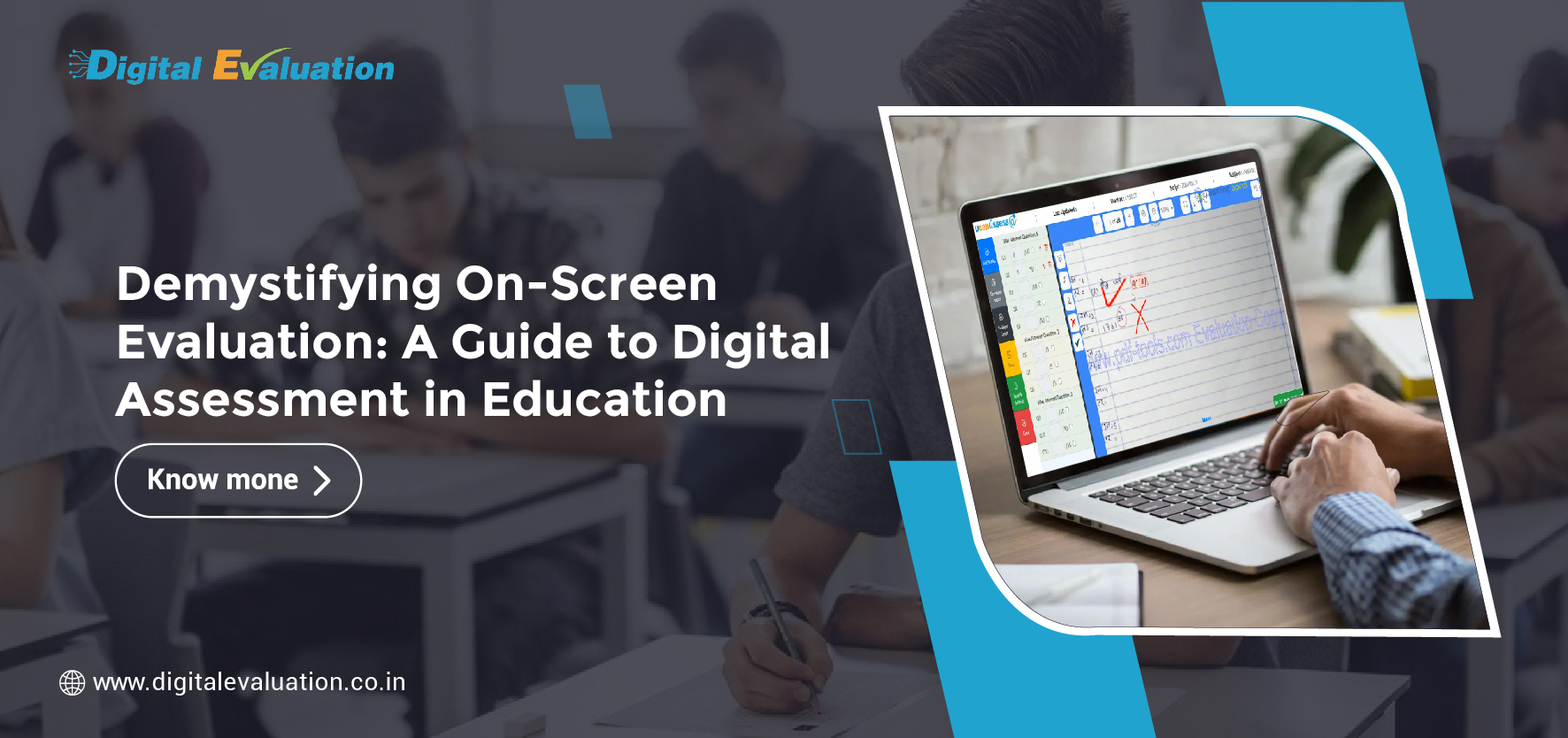
Learning Spiral’s On Screen Marking solution allows evaluators to view scripts digitally, capture marks online, and add annotations where required.
A controlled evaluation interface helps institutions establish consistent marking workflows across departments and examination centres.
Examiners can focus more directly on assessing students’ answers, while administrators can track evaluation activity through the system.
This distinction is essential: technology supports reliable evaluation, but it does not replace the academic expertise of qualified examiners.
Digital marking also opens opportunities to review evaluation consistency and reduce avoidable administrative errors.
5. Quality Assurance and Moderation: Making Every Mark Accountable
An examination result is meaningful only when the institution can trust the evaluation process behind it.
Even a well-organized marking workflow may encounter incomplete entries, unusual scoring patterns, discrepancies, or scripts requiring additional review.
Quality assurance therefore needs to be a built-in stage rather than a final-minute activity.
A good Digital Evaluation System should provide administrators with mechanisms to review awarded marks, address flagged scripts, and approve evaluation outcomes.
How Learning Spiral Helps
Learning Spiral supports structured mark collation, auditing, and approval workflows within UCanEvaluate.
Where an institution requires multiple valuation or additional scrutiny, the evaluation workflow can be configured to support the relevant process.
Administrators can oversee evaluator activity and review outcomes before marks move into final processing.
This helps build an environment in which evaluation decisions can be followed through defined operational checkpoints.
The key advantage: Quality checks are integrated into the examination workflow instead of being treated as an afterthought.
6. Post Examination Processing: Converting Evaluated Marks into Final Grades
Completing evaluation is not the same as completing the examination cycle.
After marks have been awarded, universities must handle mark consolidation, applicable grading rules, validation, result preparation, and publication.
This is where Post Examination Processing becomes critical.
A university may have thousands of evaluated scripts, but even a small mistake during mark transfer or consolidation can affect an individual student’s result.
A connected University Examination System can reduce unnecessary duplication of administrative work and improve coordination between evaluation and result processing.
How Learning Spiral Helps
Learning Spiral supports mark collation, approval, result processing, and marksheet generation through its examination solutions.
Its digital workflows help institutions move from evaluated scripts to organized, reviewable examination results.
Depending on the institution’s configured academic rules and approvals, examination departments can use these processes to prepare final results more efficiently.
Administrative staff can focus on reviewing exceptions and confirming accuracy rather than repeatedly transferring marks between disconnected records.
This is especially useful for institutions managing multiple programs, semesters, examination sessions, and result schedules.
7. Final Grading and Result Publication: Delivering Results with Confidence
For students, the most visible outcome of an examination cycle is the final result.
For universities, however, successful result publication depends on everything that happens beforehand.
Accurate answer booklet scanning, secure script mapping, proper evaluator allocation, accountable marking, and verified marks all contribute to reliable final grading.
Result publication should therefore be treated as the last stage of a carefully managed process, not an isolated administrative activity.
How Learning Spiral Helps
Learning Spiral’s UCanEvaluate solution supports marks processing, result publication or hosting, and marksheet generation.
Through its Digital Evaluation workflows, Learning Spiral helps institutions build a more connected process from scanned answer scripts to published outcomes.
Its reporting capabilities also help examination administrators access useful operational information.
The result is a more organized examination journey, where institutions can aim to reduce delays, improve accuracy, and provide a better experience for students and faculty.
Beyond Final Grading: Connecting the Entire Examination Lifecycle
Digital transformation becomes more valuable when examination preparation, administration, evaluation, and result processing can work together.
For instance, Pre Examination Processing may involve examination registration, schedule management, candidate records, and preparation of examination materials.
A secure Question Bank Management process can support structured question creation and paper preparation.
An Online Examination System or Online Exam Solution may support computer-based assessment, while an On Screen Evaluation System is particularly useful when handwritten subjective responses need to be assessed digitally.
Although these systems serve different functions, they can contribute to a more connected university examination environment.
For objective examinations, technologies such as Optical Mark Recognition can support automated reading of specially designed answer sheets. Subjective examinations, meanwhile, require an appropriate digital marking workflow with academic oversight.
As institutions modernize their University Management System, connecting these examination processes can support better coordination, reporting, and administrative decision-making.
Why Universities Choose Learning Spiral for Digital Evaluation
Technology alone does not solve examination challenges. Universities also need implementation knowledge, examination-domain expertise, and workflows that reflect their academic and operational requirements.
Learning Spiral Ltd. brings more than 25 years of domain experience working with universities, higher education institutions, and examination bodies.
Its UCanEvaluate platform has supported large-scale examination activities involving answer booklet scanning, secure evaluation, and result processing.
For example, Learning Spiral’s published client testimonials describe digital evaluation assignments involving more than 5.5 lakh answer booklets for the State Board of Technical Education, Bihar, and approximately 5 lakh answer scripts for Maulana Abul Kalam Azad University of Technology during an examination session.
These examples demonstrate the importance of combining scalable technology with disciplined examination operations.
Learning Spiral’s approach emphasizes:
Operational reliability: Designing workflows around the actual movement of examination data, from scanning to evaluation and result generation.
Security and confidentiality: Supporting controlled access, encrypted storage, identity masking, and appropriate examination safeguards.
Evaluation oversight: Helping administrators coordinate script allocation, monitor activity, and manage mark approval.
Workflow flexibility: Supporting institution-specific scanning, allocation, valuation, and examination processing requirements.
End-to-end coordination: Connecting digital evaluation with reporting, marks processing, and result publication.
Instead of asking universities to adapt every examination process to a rigid system, the aim is to build a workflow suited to their academic policies and operational scale.
Frequently Asked Questions About Digital Evaluation Systems
What is a Digital Evaluation System?
A Digital Evaluation System is a technology-enabled platform that helps institutions manage answer script digitization, electronic marking, mark verification, and examination result processing within a structured workflow.
What is the difference between On-Screen Evaluation and On-Screen Marking?
On-Screen Marking primarily refers to reviewing and grading answer scripts digitally. On-Screen Evaluation is often used more broadly to describe the electronic assessment workflow, which may include script allocation, marking, monitoring, and quality checks.
Can universities digitally evaluate handwritten answer booklets?
Yes. Handwritten answer booklets can be scanned and made available to authorized examiners through an On Screen Evaluation System without requiring students to complete their subjective examinations online.
How does digital evaluation improve grading accuracy?
It can reduce manual mark-transfer errors, support structured marking, improve traceability, and make mark review easier. Actual improvements depend on scanning quality, system configuration, evaluator training, and institutional controls.
Does a Digital Evaluation System automatically assign final grades?
Not necessarily. A reliable system supports academic evaluators and examination administrators. Final grading should follow the institution’s approved academic policies, verification processes, and authorization requirements.
Can digital evaluation work with existing university examination systems?
Integration is possible where technical interfaces, data structures, and institutional requirements permit it. Compatibility and the implementation approach should be assessed for each institution.
Conclusion: Accurate Results Begin Long Before Result Day
The real value of a Digital Evaluation System lies in connecting every stage of examination processing.
From Answer booklet scanning and secure script management to On-Screen Marking, quality checks, and final grading, every step contributes to examination reliability.
For universities and examination boards, the objective is not simply to digitize answer sheets. It is to create a secure, accountable, and efficient academic evaluation process.