
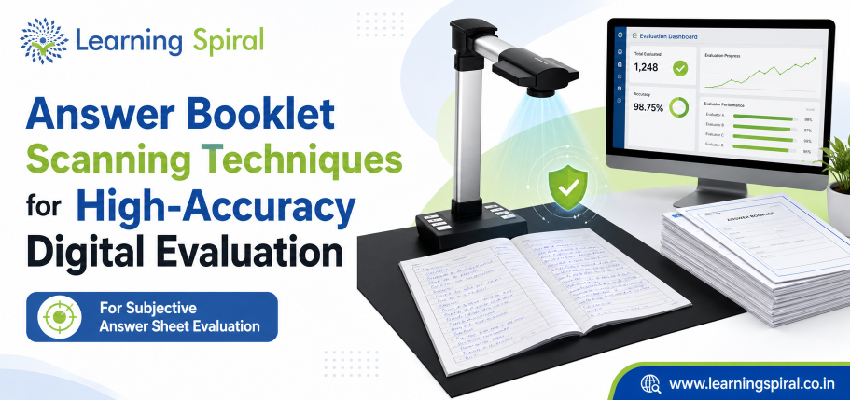
Every examination cycle generates thousands — sometimes millions — of handwritten answer booklets. Converting that paper into structured, evaluable digital records is the foundation of any reliable Digital Evaluation System. Yet the quality of this very first step, scanning, determines the accuracy of everything that follows: marking, moderation, and result generation.
For universities and examination boards transitioning away from manual correction, understanding modern Answer Booklet Scanning techniques is no longer optional. It is the backbone of trustworthy On Screen Evaluation.
Why scanning accuracy matters
A single misaligned page, blurred handwriting, or skipped sheet can distort an entire evaluation cycle. High-resolution, high-speed scanning ensures every answer booklet is captured cleanly before it ever reaches an evaluator’s screen — eliminating one of the most common sources of error in Post Examination Processing.
Core scanning techniques for high-accuracy evaluation
1. High-speed duplex scanning
Modern scanners capture both sides of a booklet simultaneously at high DPI, drastically reducing turnaround time while preserving handwriting clarity essential for fair marking.
2. Barcode and QR-based booklet identification
Each booklet is tagged with a unique barcode or QR code during scanning, enabling automatic student anonymization — a critical requirement for unbiased On Screen Marking.
3. Automated page sequencing and stitching
Intelligent software detects page order, flags missing pages, and stitches multi-sheet booklets into a single digital file — removing manual sorting from the workflow entirely.
4. Image enhancement and noise correction
Built-in algorithms correct skewed scans, remove shadows, and sharpen faint handwriting, ensuring evaluators see a true representation of the original answer sheet.
5. Secure cloud upload and encryption
Once digitized, booklets are encrypted and uploaded to a secure server, ready for distribution within an Online Examination System — maintaining chain-of-custody integrity throughout.
Benefits for universities and examination boards
- Faster result declaration — Digitized booklets move directly into evaluation queues, cutting weeks off traditional timelines
- Reduced human error — Automated sequencing eliminates lost or misfiled answer sheets
- Improved transparency — Digital records support easy re-evaluation and audit trails
- Scalability — High-volume scanning supports examinations with lakhs of candidates without added manual staff
- Better evaluator experience — Clear, enhanced scans reduce eye strain and marking inconsistency
Common challenges in implementation
- Inconsistent booklet formats across colleges or affiliated institutions
- Handling damaged, torn, or handwritten-in-margin booklets
- Bandwidth and infrastructure limitations during peak scanning periods
- Training scanning center staff on quality-check protocols
A well-designed University Examination System addresses these challenges through standardized templates, redundancy checks, and dedicated quality assurance layers built into the scanning pipeline.
The future of answer booklet scanning
Emerging trends point toward AI-assisted handwriting legibility scoring, real-time scan quality validation, and tighter integration between scanning centers and Question Bank Management platforms — creating a fully connected, paperless examination ecosystem from question paper generation to final result.
Organizations like Learning Spiral are already building these connected pipelines, combining accurate scanning infrastructure with robust On Screen Marking System capabilities to help institutions modernize assessment at scale. Learning Spiral‘s approach to Examination Processing reflects this shift — treating scanning not as an isolated task, but as the entry point to a fully digital evaluation lifecycle.
Ready to modernize your institution’s evaluation process? Explore Learning Spiral’s full range of exam automation solutions — from pre-examination processing to digital evaluation and result generation. Request a 1 – on – 1 meeting →