Imagine this: a university has spent months preparing its semester examinations. Question papers have been finalised, examination centres are ready, and thousands of students are waiting for their exams. Then, just hours before the first paper, confidential questions appear online.
Suddenly, everything is at risk.
Examinations may need to be postponed, students lose confidence, and administrators face difficult questions about how confidential information escaped.
What if technology could stop such incidents before they happen?
This is where automated Question Bank Management becomes important. By replacing scattered files, manual approvals and uncontrolled paper distribution with structured digital workflows, universities can significantly reduce opportunities for examination security breaches.
But can automation eliminate paper leaks forever?
The answer is no—not completely. However, the right combination of technology, security controls and institutional governance can make question paper leaks considerably harder to execute.
Let’s explore how.
What Is Automated Question Bank Management?
A question bank is more than a collection of examination questions. It is a structured academic resource that supports question creation, classification, review, selection and examination preparation.
Traditional approaches often involve Word documents, spreadsheets, email attachments and manual coordination between faculty members.
Automated systems transform this process.
A modern Question Bank Management approach enables authorised users to create, organise and manage examination questions within a centralised digital repository.
Questions can be categorised according to subjects, units, difficulty levels, learning outcomes, examination patterns and marks distribution.
The system can also support automated paper generation based on predefined academic requirements.
Most importantly, a well-designed platform gives institutions greater control over who can access confidential questions, when they can access them and what actions they are permitted to perform.
Instead of protecting scattered documents, universities can secure the complete question paper preparation workflow.
Why Do Question Paper Leaks Still Happen?
Question paper leaks are not always the result of sophisticated cyberattacks.
Sometimes, the most serious vulnerabilities emerge from ordinary administrative practices.
A confidential document forwarded to the wrong recipient, a shared folder with excessive permissions, an unsecured printing process or compromised user credentials may expose sensitive examination material.
Consider a university where multiple faculty members, moderators, administrative staff and printing vendors handle the same question paper.
Every additional handover creates another potential point of exposure.
Traditional examination workflows may struggle with three critical challenges.
First, limited access visibility. Administrators may not have reliable records showing who accessed or downloaded confidential materials.
Second, uncontrolled document circulation. Once a question paper is distributed through email or removable storage, tracking additional copies becomes difficult.
Third, excessive manual dependencies. Repeated printing, physical transportation and last-minute exchanges can increase exposure risks.
This is why examination security must begin long before students enter the examination hall.
7 Ways Automated Question Bank Management Helps Prevent Paper Leaks
1. Centralised and Secure Question Storage
One of the biggest advantages of automated Question Bank Management is the ability to store examination questions within a controlled digital environment.
Rather than maintaining multiple copies across computers, departments and email accounts, institutions can use a central repository with defined access permissions.
A secure Question Bank Management platform can support organised question libraries, encryption, version control and structured administrative workflows.
This reduces uncontrolled document circulation and helps institutions maintain greater visibility over sensitive examination content.
2. Role-Based Access Control
Not everyone involved in examination preparation needs access to the complete question paper.
A question author may only need permission to create questions. A moderator may need to review submissions, while the Controller of Examinations may require final approval privileges.
Role-based access control allows universities to define these permissions separately.
For example, a faculty member preparing questions for one subject should not automatically gain access to papers belonging to other departments.
When combined with strong authentication, the principle of least privilege can significantly reduce unnecessary exposure.
3. Encryption of Confidential Examination Materials
Encryption is an essential security measure for protecting sensitive examination information.
A properly designed system can encrypt question bank data during storage and transmission, reducing the risk of readable information being exposed if files or communications are intercepted.
However, encryption must be accompanied by secure key management, reliable authentication and restricted permissions.
After all, an encrypted question paper can still be compromised if an attacker obtains authorised access.
The objective is not simply to protect files but to secure the entire process through which those files become accessible.
4. Automated Question Paper Generation
Preparing question papers manually can involve repeated document exchanges, formatting adjustments and approvals.
Automated Question Bank Management can simplify this process through predefined examination blueprints.
Approved questions can be selected according to subject coverage, difficulty, marks distribution and other academic criteria.
Institutions can also generate multiple paper versions when appropriate, reducing dependence on a single repeatedly circulated document.
However, automation must preserve academic quality.
Faculty experts should review the final papers to confirm syllabus coverage, clarity, balanced difficulty and the absence of errors.
5. Time-Controlled Question Paper Distribution
A confidential question paper should ideally become accessible only when operationally necessary.
Automated security workflows can help institutions establish controlled release schedules.
With appropriate authentication and permissions, examination centres can receive access to approved papers within a predefined time window.
This can reduce the period during which confidential examination materials remain exposed.
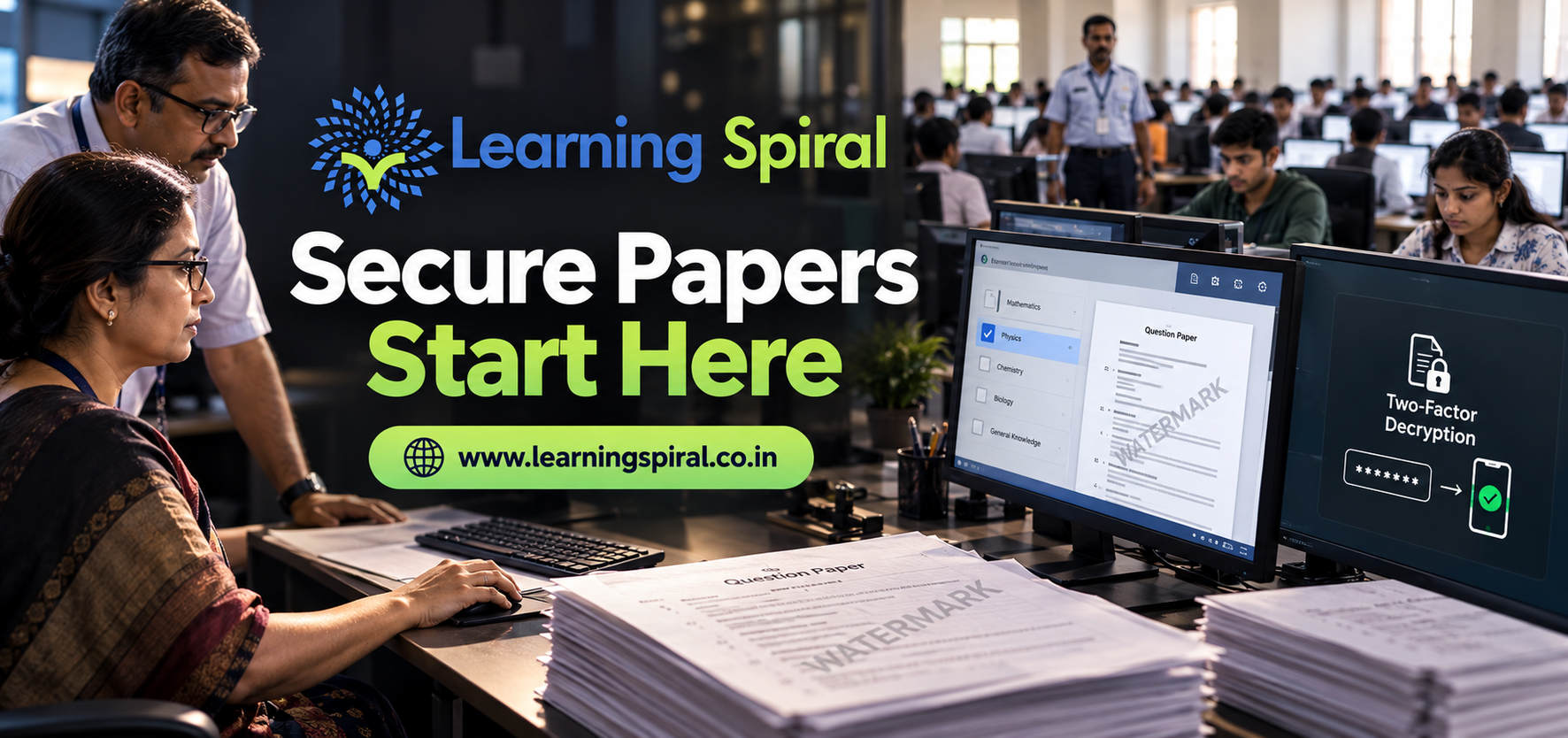
Solutions such as Learning Spiral’s UCanSecure focus on controlled question paper creation and secure distribution, helping examination bodies manage sensitive materials across the question paper lifecycle.
6. Real-Time Monitoring and Audit Trails
Imagine discovering a suspicious question paper download without knowing which account performed it.
This is a common difficulty when universities depend on manual workflows.
A properly configured digital system can record important events such as user logins, document access, approvals, downloads and administrative changes.
These audit trails can help authorised administrators investigate unusual activity and establish accountability.
Monitoring does not automatically prevent every security incident, but it improves the institution’s ability to detect, investigate and respond to suspicious behaviour.
7. Reduced Dependence on Manual Handling
Traditional paper preparation may require physical printing, packaging, transportation and storage before examination day.
Every stage requires careful supervision.
Automated paper creation and controlled digital distribution can reduce the number of physical handovers.
By limiting unnecessary handling and establishing a more traceable process, universities can reduce several opportunities for accidental disclosure or deliberate misuse.
The result is a more manageable and security-conscious examination workflow.
Can AI Make Question Bank Management Even More Secure?
Artificial intelligence can improve the efficiency of Question Bank Management, particularly when universities maintain thousands of questions across subjects and semesters.
AI-assisted classification can help organise questions by topic, complexity and learning objectives.
Automated analysis can also help identify duplicate or excessively reused question patterns.
When combined with predefined examination blueprints, intelligent selection tools can assist in preparing different question paper combinations.
However, AI-generated or AI-selected questions should not bypass academic review.
AI systems can produce inaccurate questions, ambiguous wording or unsuitable difficulty levels.
Furthermore, AI does not automatically prevent an authorised person from copying confidential content.
Its greatest value lies in supporting efficient question selection, reducing repetitive administrative work and strengthening the quality of examination preparation when accompanied by human oversight.
How Does Question Bank Management Fit Into a University Examination System?
Question paper security is only one part of the examination lifecycle.
Universities also need reliable processes for student registration, examination scheduling, assessment delivery, answer-script evaluation and result declaration.
A connected University Examination System helps institutions coordinate these activities through more consistent digital workflows.
During Pre Examination Processing, universities manage academic requirements, examination schedules, candidate eligibility, question paper preparation and confidential approvals.
Question Bank Management supports this stage by organising approved examination content and controlling access.
During examination delivery, an Online Examination System can support secure digital assessments, question presentation, candidate responses and examination monitoring.
Such systems form part of the broader concept of Online Assessment, where technology supports the administration and management of assessments.
For traditional written examinations, the workflow continues after students submit their answer booklets.
Answer booklet scanning and the Scanning of Answer Sheets help convert physical scripts into digital records.
These digital scripts can then be allocated to authorised evaluators through On Screen Evaluation and On-Screen Marking workflows.
A connected Digital Evaluation System can support secure examiner access, digital marking, moderation, marks compilation and evaluation monitoring.
Finally, Post Examination Processing supports result verification, tabulation, grade calculation, publication and related academic activities.
When these systems connect with a broader University Management System, institutions can reduce fragmented administrative processes and maintain better examination records.
Although these post-examination technologies do not directly stop question paper leaks, they form part of a more accountable and integrated examination ecosystem.
Can Automated Systems Eliminate Paper Leaks Forever?
This is the most important question.
Even the most sophisticated Question Bank Management System cannot guarantee that confidential examination material will never be compromised.
Technology can restrict access, encrypt information, automate approvals and record suspicious activity.
However, human and operational risks still exist.
Authorised users may misuse their privileges. Passwords may be compromised. Endpoint devices may become infected with malware. Poorly configured permissions or insecure printing arrangements may expose sensitive materials.
A university could invest in advanced software and still remain vulnerable if its employees share credentials or its security procedures are poorly enforced.
Therefore, the goal should not be to promise absolute prevention.
The realistic goal is to reduce exposure, minimise opportunities for unauthorised access, strengthen accountability and improve incident response.
Effective security requires a combination of reliable technology, trained personnel, documented procedures, periodic audits and continuous improvement.
How Learning Spiral Ltd. Supports Secure Examination Management
At Learning Spiral Ltd., we understand that examination security is not simply an IT concern.
It directly affects student confidence, institutional credibility and the integrity of academic assessment.
Our examination technology solutions help universities, examination boards and educational institutions modernise important stages of the assessment lifecycle.
UCanAssess supports structured Question Bank Management, question categorisation, automated paper preparation and digital assessment workflows.
UCanSecure supports controlled question paper creation and distribution through security-focused digital workflows designed for examination authorities.
UCanEvaluate enables Digital Evaluation and On Screen Marking, helping institutions digitise handwritten answer booklets, manage evaluator allocation and streamline marks processing.
Together with our broader examination management solutions, these platforms help institutions reduce fragmented workflows and improve operational control.
Whether an institution wants to strengthen examination confidentiality, manage a growing question repository or modernise its complete Examination Processing workflow, Learning Spiral offers technology-driven solutions suited to institutional requirements.
What Should Universities Check Before Adopting an Automated Question Bank?
Before selecting a Question Bank Management solution, university administrators should ask a few important questions.
Can the platform restrict access according to academic roles and responsibilities?
Does it support encryption, secure authentication and traceable approval workflows?
Can question papers be generated according to approved syllabus coverage, difficulty levels and marks distribution?
Are audit logs available to investigate unusual access or administrative changes?
Can confidential papers be distributed through controlled release windows?
And most importantly, does the institution have policies for faculty training, security reviews, incident management and emergency examination arrangements?
The answers will reveal whether the proposed platform supports a genuinely secure examination process or merely digitises the existing paperwork.
Frequently Asked Questions
1. Can Question Bank Management completely prevent examination paper leaks?
No system can guarantee complete prevention. However, automated Question Bank Management can significantly reduce certain risks through controlled access, encryption, secure paper generation and traceable workflows.
2. Is automated question paper generation safer than manual preparation?
It can be safer when implemented with strong security controls. Automated generation reduces unnecessary document handling and can limit paper circulation, but academic review and secure distribution remain essential.
3. Can Question Bank Management integrate with an Online Examination System?
Yes. Modern Question Bank Management platforms can connect with Online Examination Systems to support question selection, assessment delivery and related examination operations. Integration capabilities depend on the selected software and its configuration.
4. Does Question Bank Management also improve Digital Evaluation?
Question Bank Management primarily supports the pre-examination stage. When integrated with Digital Evaluation and On-Screen Evaluation systems, it can contribute to a more coordinated examination lifecycle, although these technologies serve different purposes.
5. Is automated Question Bank Management suitable for large universities?
Yes. A scalable platform can help large institutions organise extensive question repositories, manage multiple academic programmes and coordinate examination preparation across departments and campuses.
Final Thoughts: Secure Examinations Begin Before Exam Day
Automated Question Bank Management may not eliminate examination paper leaks forever, but it can fundamentally change how universities protect confidential assessment content.
By replacing uncontrolled document circulation with structured digital repositories, access restrictions, automated generation, monitoring and secure distribution, institutions can strengthen their examination security posture.
The future of examination integrity is not about trusting technology blindly.
It is about combining intelligent systems with responsible institutional governance.
Because protecting a question paper means protecting the fairness of the examination itself.
Ready to Strengthen Your University’s Examination Security?
Learning Spiral Ltd. helps educational institutions modernise their Question Bank Management, Online Examination System, On-Screen Evaluation and Digital Evaluation workflows.
Connect with our team to discuss examination security challenges and explore solutions aligned with your institution’s needs.