What This Article Covers
- What Is Integrated Digital Evaluation?
- Why It Matters for Your UMS
- How the Integration Works
- Manual vs. Integrated Evaluation
- Pitfalls to Avoid
- FAQs
Introduction
Most universities run three “core” systems that were never built to talk to each other: admissions, academics, and evaluation. Marks get evaluated in one place and re-entered by hand into another. That single handoff is usually where result delays, transcription errors, and grievances originate – not the evaluation itself.
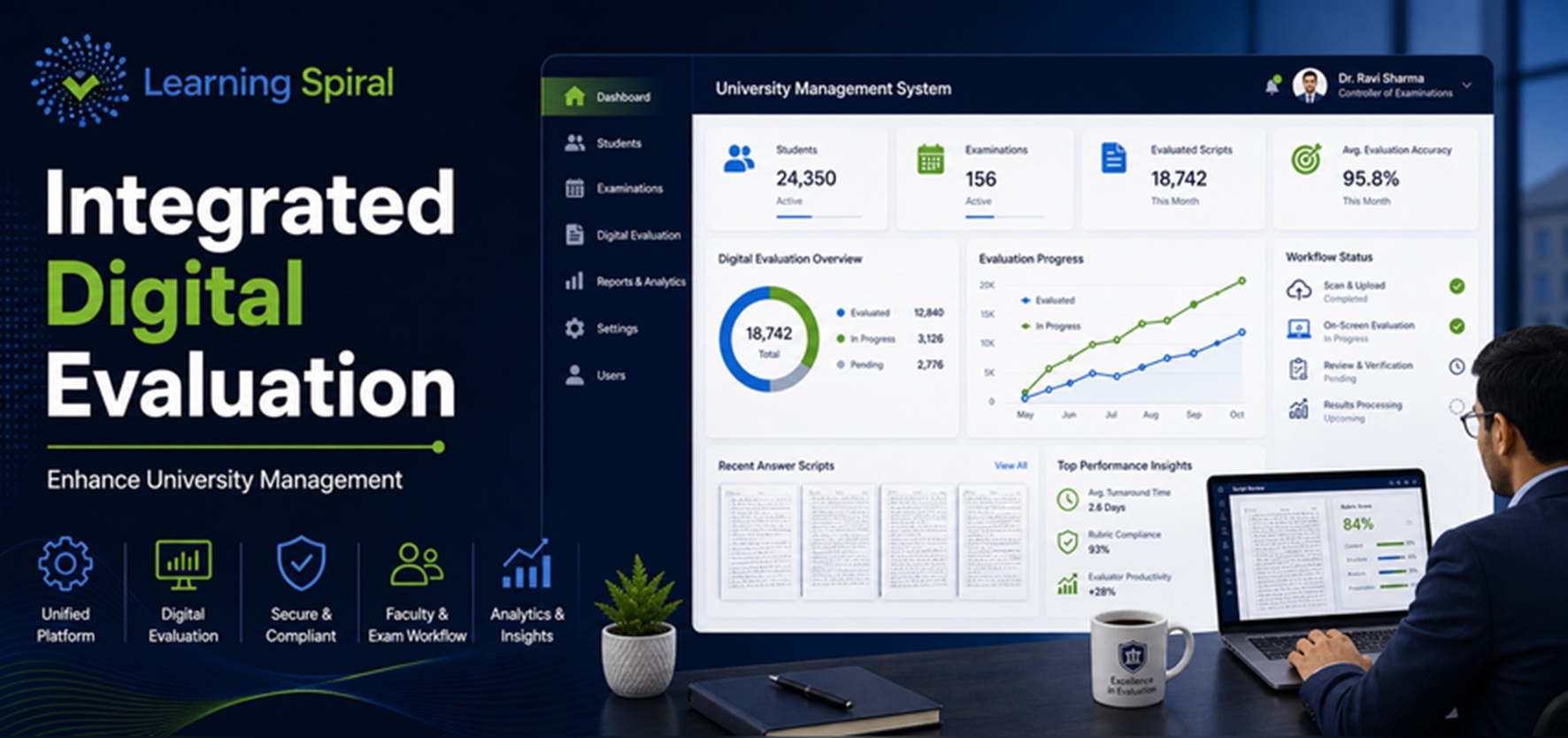
What is integrated digital evaluation? It’s a digital evaluation layer that connects directly with a university’s Management System, so student data flows in and final marks flow out automatically – no manual re-entry, no disconnected spreadsheets, and a single audit trail from answer script to result.
Why It Matters for Your UMS
When evaluation sits outside the UMS, a few problems show up every cycle:
- Duplicate data entry — marks get keyed in twice, introducing avoidable errors
- Fragmented audit trails — no single record of who evaluated what and when
- Slower result declaration — every manual handoff adds days
- Harder grievance resolution — records live in two or three different places
- Messier accreditation reporting — NAAC/NBA/UGC audits expect a traceable pipeline
None of this is a flaw in the UMS itself — it’s simply that evaluation was never designed as part of the same data fabric.
How the Integration Works
- Student and course data sync — the UMS pushes enrollment and subject data to the evaluation platform automatically
- Answer script linkage — scanned scripts are matched to the right student and subject via QR/barcode, keeping marking anonymized
- Onscreen evaluation and moderation — evaluators mark digitally, with moderation rules applied automatically
- Automated mark computation — internal, practical, and theory marks are aggregated against the grading scheme
- Result push-back — finalized marks flow straight into the student’s academic record, triggering grade cards and notifications
Manual vs. Integrated Evaluation
| Parameter | Disconnected Systems | Integrated Digital Evaluation |
|---|---|---|
| Mark entry | Manual, re-keyed | Direct system-to-system transfer |
| Audit trail | Fragmented | Single record per student |
| Result declaration | Weeks | Days |
| Grievance handling | Multiple sources to pull from | One unified history |
| Accreditation reporting | Assembled manually | Available on demand |
Pitfalls to Avoid
| Pitfall | How to Avoid It |
|---|---|
| Treating evaluation as a bolt-on | Evaluate platforms on integration depth, not just features |
| No shared student ID across systems | Standardize a single unique ID before go-live |
| Rolling out to all departments at once | Pilot with one department or affiliated college first |
| Ignoring affiliated college data formats | Build a standardized data template early |
| Skipping staff training | Train examination cell staff alongside evaluators |
Institutions working with an experienced examination technology partner typically see evaluation turnaround improve by 40–50%, without compromising accuracy, once evaluation is genuinely integrated rather than run alongside the UMS.
Frequently Asked Questions
Will this work with our existing UMS or ERP vendor? Most modern digital evaluation platforms use open APIs designed to connect with existing infrastructure, rather than requiring a full replacement.
How long does a rollout typically take? A phased rollout – one department first, then institution-wide – commonly takes 60–90 days depending on how standardized your data already is.
Does this affect data security? Done well, integration improves security by replacing scattered files with a single, access-controlled, audit-logged system.
Can it handle large volumes, like 1 lakh answer scripts a cycle? Yes – this is exactly where the time savings from automated data flow become most significant.
Is it aligned with NEP 2020 and UGC evaluation reform expectations? Yes. The UGC’s guidance on evaluation reforms calls for greater transparency and faster turnaround – both of which integrated evaluation is built to support.
Conclusion
Universities rarely lose time inside evaluation or inside their UMS – they lose it in the space between the two. Learning Spiral Ltd. has spent 25+ years helping Universities and Examination Boards across India close exactly that gap.
Curious what this looks like for your institution? Schedule a consultation or explore a related case study.