
For a student, an examination may last only a few hours.
For a university, it can be a weeks-long operation involving student records, subject mapping, question preparation, examination schedules, hall tickets, answer scripts, evaluators, marks, moderation, revaluation and finally—results.
The real challenge is therefore not simply conducting an examination. It is managing every process before, during and after the examination without creating disconnected workflows, duplicate data entry or avoidable administrative delays.
That is where a modern University Examination System changes the equation.
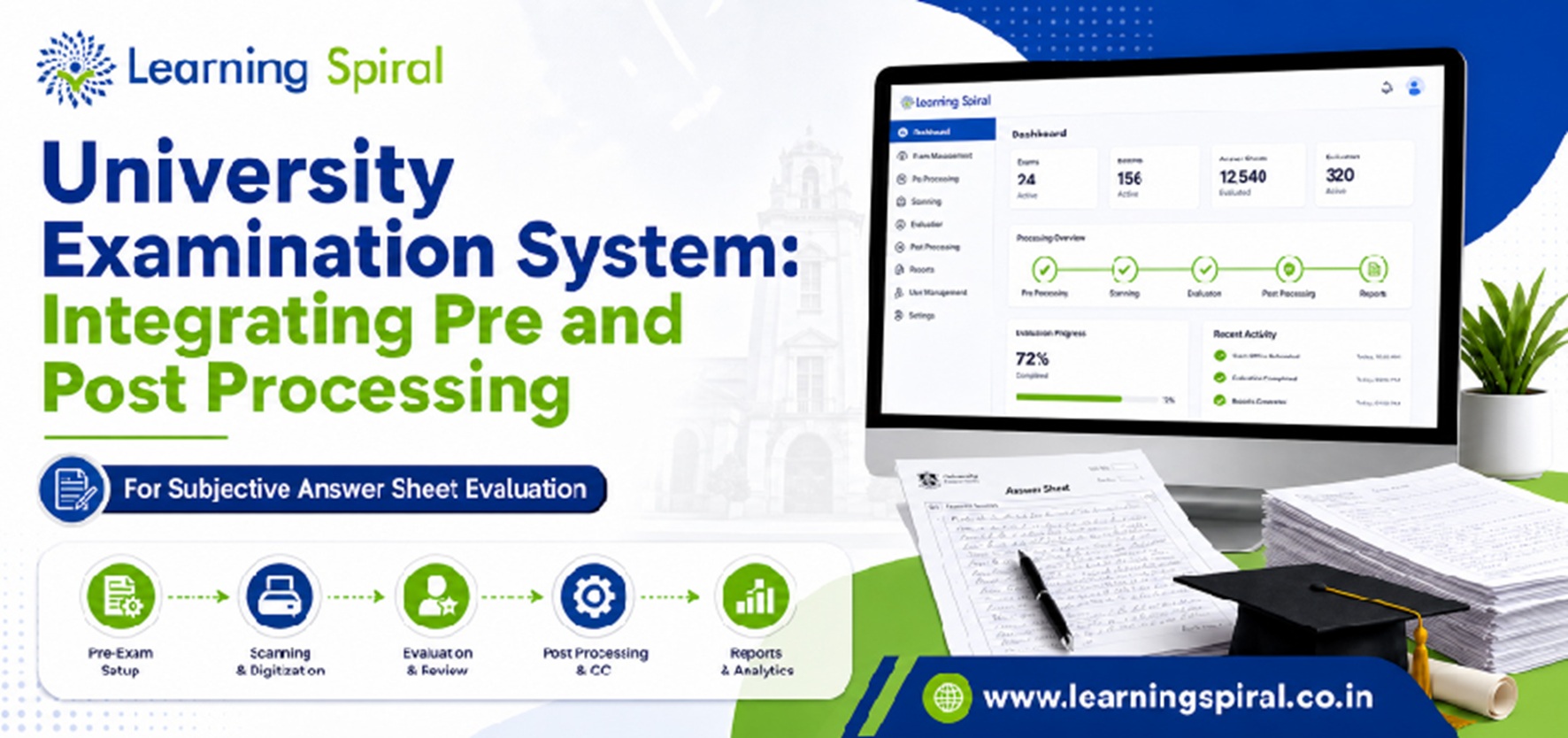
Instead of treating Pre Examination Processing, examination delivery, Digital Evaluation and Post Examination Processing as separate activities, an integrated system connects them into a continuous digital workflow.
The result is a more structured examination lifecycle in which data moves with the process—from question creation to final result publication.
Why Examination Processing Needs to Be Viewed as One Connected Workflow
Traditional university examination operations can become fragmented because different teams often handle different stages.
The examination department may manage registration and scheduling. Faculty members may prepare questions. Examination centres may handle physical answer booklets. Evaluators may work independently, while another team processes marks and publishes results.
Individually, each process may work.
The problems often begin at the handoffs.
A missing student record, incorrect subject mapping, delayed answer script movement or manual marks entry can affect everything that follows.
Modern Examination Processing therefore works best when the complete examination lifecycle is designed as one connected system consisting of:
- Pre Examination Processing
- Examination management and administration
- Answer booklet digitisation
- Digital Evaluation and On Screen Marking
- Post Examination Processing
- Result preparation, publication and analysis
Let us look at each stage more closely.
1. Pre Examination Processing: Where an Accurate Exam Really Begins
A reliable examination workflow starts well before exam day.
Pre Examination Processing creates the operational foundation upon which the rest of the examination cycle depends.
Typical pre-examination activities can include:
- • Student and examination registration
- • Subject and paper mapping
- • Eligibility verification
- • Examination form processing
- • Examination timetable preparation
- • Centre and venue allocation
- • Candidate roll number generation
- • Admit card or hall ticket generation
- • Evaluator and examiner configuration
- • Question paper preparation and approval
When these processes depend heavily on independent spreadsheets, emails and physical documents, examination teams may have to repeatedly verify the same information.
An integrated system reduces these disconnected handoffs by maintaining structured examination data that can continue into later stages.
2. Question Bank Management: Moving Beyond Manual Question Paper Creation
Question paper preparation is one of the most sensitive parts of an examination cycle.
Universities need to maintain confidentiality while also ensuring appropriate syllabus coverage, difficulty levels, marks distribution and question quality.
A digital Question Bank Management system can help institutions create a structured repository of questions instead of relying exclusively on documents exchanged through email or manually maintained files.
A modern Question Bank Management workflow can support:
- • Centralised question repositories
- • Subject-wise and topic-wise categorisation
- • Different question formats
- • Difficulty-level mapping
- • Question moderation
- • Role-based access
- • Question paper generation
- • Controlled approval workflows
- • Secure paper management
The important advantage is not simply digitisation. It is traceability.
Every stage—from question creation to approval—can become part of a defined examination workflow.
3. Conducting Assessments Through an Integrated Online Examination System
Depending on the type of examination, institutions may conduct conventional written examinations, computer-based examinations or a combination of both.
An integrated Online Examination System can support institutions that need an Online Exam Solution for large-scale assessments, university examinations, entrance tests or other academic evaluations.
The examination layer may include:
- • Candidate authentication
- • Question delivery
- • Examination scheduling
- • Time-controlled assessments
- • Secure question access
- • Response capture
- • Examination monitoring
- • Submission management
For institutions adopting Online Assessment, the examination and response-capture process can become digital from the beginning.
Paper-based university examinations, however, can also benefit significantly from digitisation—especially once the examination is completed.
That brings us to one of the most important transitions in the entire workflow.
4. Answer Booklet Scanning: The Bridge Between Paper Exams and Digital Evaluation
A university does not necessarily need to eliminate handwritten examinations to modernise its evaluation process.
Physical answer scripts can be digitised through Answer Booklet Scanning.
During the Scanning of Answer Sheets, physical scripts are converted into digital copies that can be securely processed and allocated for evaluation.
A structured scanning workflow may involve:
- Script identification
Each answer booklet is associated with the correct examination and candidate record. - Scanning
Answer booklets are converted into readable digital scripts. - Quality verification
Pages can be checked for visibility, orientation, completeness and scanning quality. - Secure upload
Validated scripts become available within the Digital Evaluation System. - Evaluator allocation
Scripts are assigned to authorised evaluators according to the institution’s workflow.
Answer booklet scanning therefore does more than turn paper into an image.
It creates the digital foundation required for On Screen Evaluation.
5. On Screen Evaluation: Turning Physical Scripts Into Digital Marking Workflows
Once answer booklets have been digitised, universities can shift the evaluation process from physical script movement to On-Screen Evaluation.
On Screen Evaluation, also referred to as On-Screen Evaluation, allows authorised evaluators to access digitised answer scripts through a digital platform instead of receiving bundles of physical answer sheets.
The same workflow is frequently described as On Screen Marking or On-Screen Marking.
With an On Screen Marking System, examiners can review scripts, enter marks and work within a controlled digital evaluation environment.
Depending on institutional requirements, an On-Screen Marking System may support:
- • Digital answer script viewing
- • Question-wise marking
- • Annotation capabilities
- • Structured mark entry
- • Evaluator allocation
- • Monitoring of evaluation progress
- • Review and moderation workflows
- • Audit trails
- • Marks collation
This creates an important shift: the answer booklet no longer has to physically travel wherever the evaluator goes.
The examination workflow can move digitally instead.
6. Why Digital Evaluation Is More Than “Checking Papers on a Screen”
It is easy to think of Digital Evaluation as simply replacing a physical answer sheet with an image on a monitor.
The real transformation is much broader.
A Digital Evaluation System can connect scanning, script allocation, evaluator activity, marks capture, moderation and result processing within one structured workflow.
That gives examination administrators greater visibility over questions such as:
- • How many scripts have been scanned?
- • How many scripts are ready for evaluation?
- • How many have already been evaluated?
- • Which scripts require review?
- • Where is moderation pending?
- • Are marks ready for final processing?
Instead of waiting until the end of the exercise to identify bottlenecks, administrators can track progress throughout the evaluation cycle.
This makes the On Screen Evaluation System not simply an evaluator tool, but an operational layer within the wider University Examination System.
7. Post Examination Processing: Where Evaluation Becomes a Result
Finishing evaluation does not mean the university examination process is finished.
The next phase—Post Examination Processing—is equally important.
After marks have been captured, institutions may still need to complete:
- • Marks verification
- • Moderation
- • Marks collation
- • Grace-rule processing, where applicable
- • Result calculation
- • Result approval
- • Grade generation
- • Marksheet preparation
- • Result publication
- • Revaluation or scrutiny workflows
- • Academic reporting
In disconnected environments, marks may need to be exported from one system and re-entered into another.
Every manual transfer introduces another opportunity for delay or mismatch.
An integrated University Examination System can reduce these repeated handoffs by allowing information from the evaluation stage to flow into Post Examination Processing more systematically.
8. Connecting Examination Processing With the Wider University Management System
Examination operations do not exist in isolation.
Student registration, academic programmes, subject combinations, semester information, enrolment records and final academic outcomes are all connected.
That is why integration with a University Management System becomes valuable.
Instead of maintaining separate versions of the same student information across departments, connected systems can create a more consistent flow of academic data.
The examination ecosystem can then connect:
Student records → Examination registration → Question management → Examination → Answer booklet scanning → On-Screen Marking → Results → Academic records
This is the larger goal of digital transformation in examination administration: not merely replacing paper, but removing unnecessary breaks in the workflow.
9. What Universities Should Look for in a Modern University Examination System
Before adopting or upgrading an examination platform, institutions should evaluate the complete workflow rather than focusing on one isolated feature.
A strong solution should address the following areas:
- End-to-end workflow coverage
The platform should support processes before, during and after examinations. - Question security
Question Bank Management should provide controlled access and structured authorisation. - Scalability
The system should be capable of supporting the institution’s examination volumes. - Answer script digitisation
Answer Booklet Scanning should integrate smoothly with the evaluation process. - Digital marking capabilities
The On Screen Evaluation System should make marking structured and manageable for evaluators. - Auditability
Examination administrators should be able to trace important actions throughout the workflow. - Post-examination integration
Marks should move efficiently into result-processing workflows. - Reporting and analytics
Administrators should have visibility into examination and evaluation progress. - Integration capabilities
The system should be capable of working with existing university processes and relevant digital platforms.
10. The Biggest Shift: From Separate Exam Activities to One Examination Lifecycle
The strongest argument for examination digitisation is not that every existing manual activity should simply be recreated on a computer.
The opportunity is larger.
A modern University Examination System can redesign the complete lifecycle so that information entered at one stage becomes useful at the next.
Pre Examination Processing prepares accurate candidate and examination data.
Question Bank Management structures question preparation.
An Online Examination System can support digital assessments where required.
Answer booklet scanning brings handwritten examinations into a digital environment.
On Screen Evaluation and On-Screen Marking organise evaluation.
Post Examination Processing converts verified marks into final academic outcomes.
When these stages operate together, Examination Processing becomes a connected workflow rather than a chain of disconnected tasks.
How Learning Spiral Supports the Complete Examination Journey
Learning Spiral Ltd. provides technology solutions designed around examination and university workflows, including Question Bank Management, Online Examination System capabilities, answer booklet scanning, Digital Evaluation, On Screen Evaluation and broader examination-management processes.
For institutions exploring an Online Exam Solution or planning to integrate Pre Examination Processing with Post Examination Processing, the objective should be straightforward:
Create one examination ecosystem in which every stage supports the next.
Because faster result processing does not begin at the result stage.
It begins with better examination workflow design.
Ready to Modernise Your University Examination Workflow?
If your institution is evaluating ways to streamline question management, examination administration, answer script scanning, digital evaluation, On Screen Marking or result processing, connect with Learning Spiral Ltd.