
Every university controller of examinations knows the real pressure begins after the last paper is submitted. Thousands of answer booklets must be transported, distributed, evaluated, totalled, re-checked and finally converted into results. A single misplaced booklet or a miscalculated total can turn into weeks of student grievances.
This is exactly why On Screen Evaluation has moved from a futuristic idea to a mainstream necessity for universities and examination boards across India. But the question every stakeholder quietly asks is simple: can a screen really judge answers as fairly as a human holding a paper?
Let us answer that honestly.
What Is On Screen Evaluation?
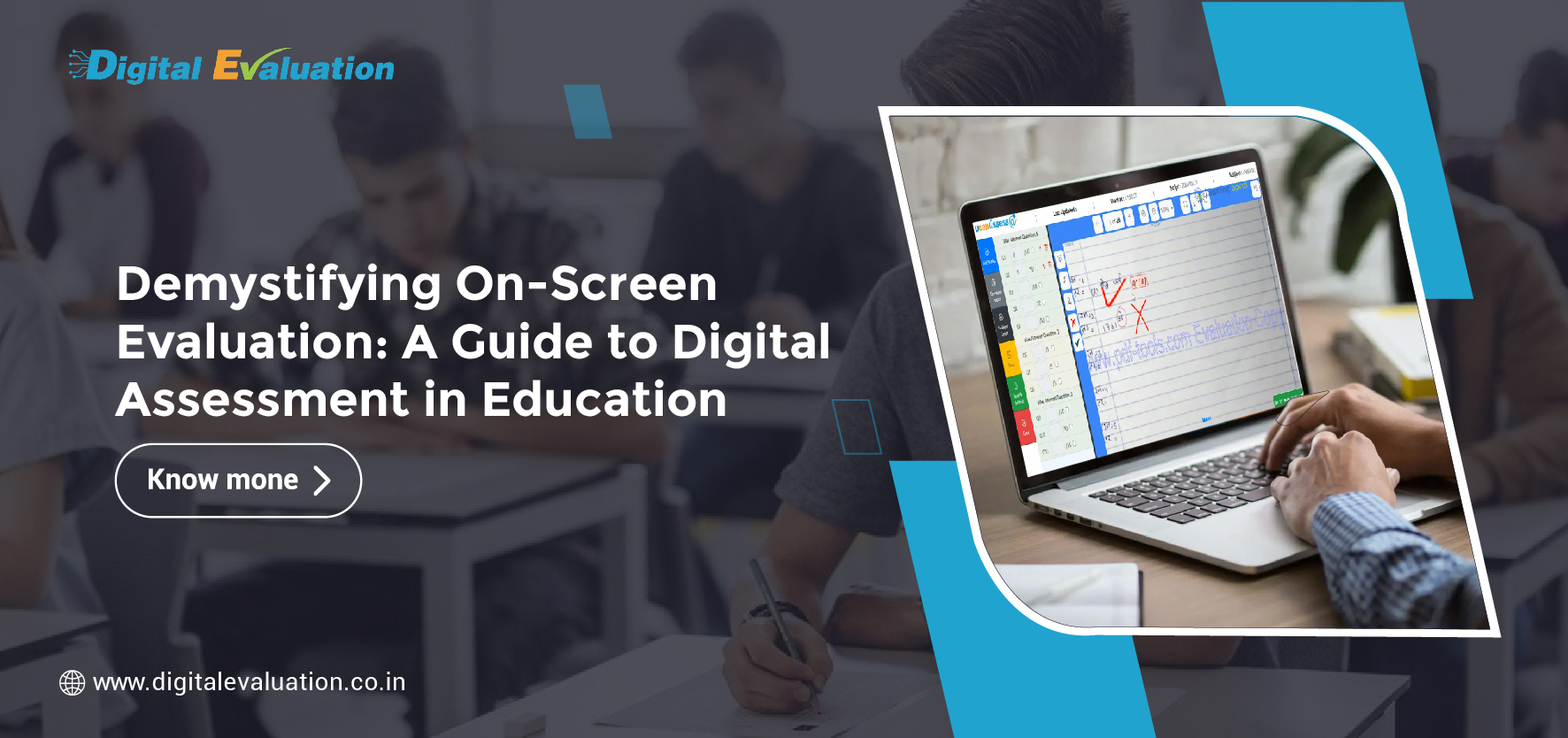
On-Screen Evaluation is a method in which handwritten answer sheets are converted into secure digital images and then assessed by examiners on a computer screen instead of on paper. The examiner reads the scanned answer, awards marks question by question using digital tools, and the system totals everything automatically.
The process begins with Answer booklet scanning, where every page of a booklet is captured as a high-resolution image, ideally without cutting or damaging the original. Each image is mapped to the right student and question through coded identifiers, so the evaluator never sees the student’s identity.
In short, the handwriting remains human, the judgement remains human, but the logistics, arithmetic and tracking become digital.
How On Screen Marking Actually Works
Think of On Screen Marking as a carefully choreographed relay race with four stages.
First comes scanning and indexing, where booklets are digitised and tagged. Next comes allocation, where the system distributes scripts to qualified examiners according to subject and workload. Then comes evaluation, where examiners annotate and mark each answer using on-screen tools and predefined marking schemes. Finally comes result generation, where marks are validated, totalled and passed into the result pipeline automatically.
A well-built On Screen Marking System also locks the marking scheme, prevents totalling errors, blocks skipped questions and records every action in an audit trail. That last feature matters a great deal when it comes to trust, and we will return to it shortly.
Why Institutions Are Switching to a Digital Evaluation System
The shift is not about novelty. It is about solving problems that manual checking has carried for decades.
Manual evaluation often means physical transit risk, delayed results and inconsistent grading between examiners. A Digital Evaluation System attacks each of these directly. Scripts never leave a secure environment, so there is no courier, no loose bundle and no lost booklet. Examiners can work from approved evaluation centres, which compresses the evaluation window dramatically. Totalling mistakes disappear because calculation is automated. And because the process is traceable, grievances and revaluation requests become easier to resolve.
Institutions that pair this with a modern On Screen Marking System are able to announce results far earlier than before, which in turn protects the academic calendar and student admissions timelines.
Can You Truly Trust On Screen Evaluation?
Here is the honest answer: you can trust it as much as you trust the system behind it. Technology alone does not create fairness. Design, security and training do. A dependable setup rests on five pillars.
Quality of scanning. If the scanned images are blurry, cropped or misaligned, the examiner cannot judge the answer properly. Professional scanning workflows with quality checks at every stage ensure that what appears on screen is a faithful copy of what the student wrote.
Anonymity and confidentiality. Roll numbers and identifying details are masked, and scripts are hosted on secure cloud infrastructure with disaster recovery. This reduces bias and protects sensitive student data.
Controlled evaluation. Marking schemes are fixed inside the system. Examiners cannot award marks beyond the maximum for a question, and moderation can be applied where marks look unusually high or low.
Examiner training. Teachers who are comfortable with the interface evaluate more confidently. Good vendors train evaluators before the first script is opened.
Transparency. Every mark, every change and every login is recorded. If a student questions a result, the institution can trace exactly what happened.
When these pillars are strong, digital marking is often more consistent than manual checking. When they are weak, even the best software cannot rescue the process. The lesson for any university is to choose an experienced partner rather than just a tool.
Proof That Scale Is Possible
Large-scale deployments show what a mature setup can achieve. Learning Spiral has supported the digital evaluation of around 1.5 lakh answer scripts for the Haryana Board, using booklet scanning without cutting, evaluator training and AWS hosting with disaster management. Similar work has covered more than 5 lakh answer scripts for MAKAUT and over 5.5 lakh booklets, nearly 1.4 crore pages, for the State Board of Technical Education, Bihar. The Haryana board’s journey also resulted in near-zero grievances and about a 50% improvement in evaluation quality of theory papers.
Numbers like these matter because trust is built on repeatability, not promises.
Where On Screen Evaluation Fits in the Bigger Exam Picture
Marking is only one chapter of the story. A truly reliable University Examination System connects everything: pre-examination activities such as forms, hall tickets and coding; the paper itself; and post-examination work such as results, mark sheets and revaluation.
That is why strong Question Bank Management deserves equal attention. A well-organised, secure Question Bank Management process improves paper quality, reduces last-minute errors and lowers leak risk before a single booklet is ever written on.
Likewise, institutions adopting a secure Online Assessment model for objective papers can pair it with on-screen marking for descriptive ones, creating one consistent Online Examination System across formats. Understanding how assessment works at a fundamental level also helps universities design evaluation that is fair rather than merely fast.
Getting Ready: A Practical Perspective
Moving to digital marking is a change-management journey as much as a technology one. Start by reviewing your current Examination Processing workflow end to end, from Pre Examination Processing such as student data and coding, through to Post Examination Processing such as result compilation and certificates. Then pilot on a limited set of subjects, train examiners, gather feedback and scale up.
Institutions that treat this as part of a wider Digital Evaluation System transformation, rather than a one-time purchase, tend to see the most durable benefits, from faster results to happier students and staff.
The Verdict
So, can you trust On Screen Evaluation? Yes, when it is built on high-quality scanning, strict confidentiality, controlled marking and transparent audit trails. The screen does not replace the examiner. It simply removes the friction, delay and arithmetic errors that surround the examiner.
If your institution is exploring Digital Evaluation, a dependable Online Exam Solution or a complete University Management System, the best next step is a conversation with a team that has done it at scale.
Talk to Learning Spiral
With 25+ years of domain experience and work across 100+ universities and examination bodies, Learning Spiral helps institutions move from slow, manual processes to reliable digital ones.