
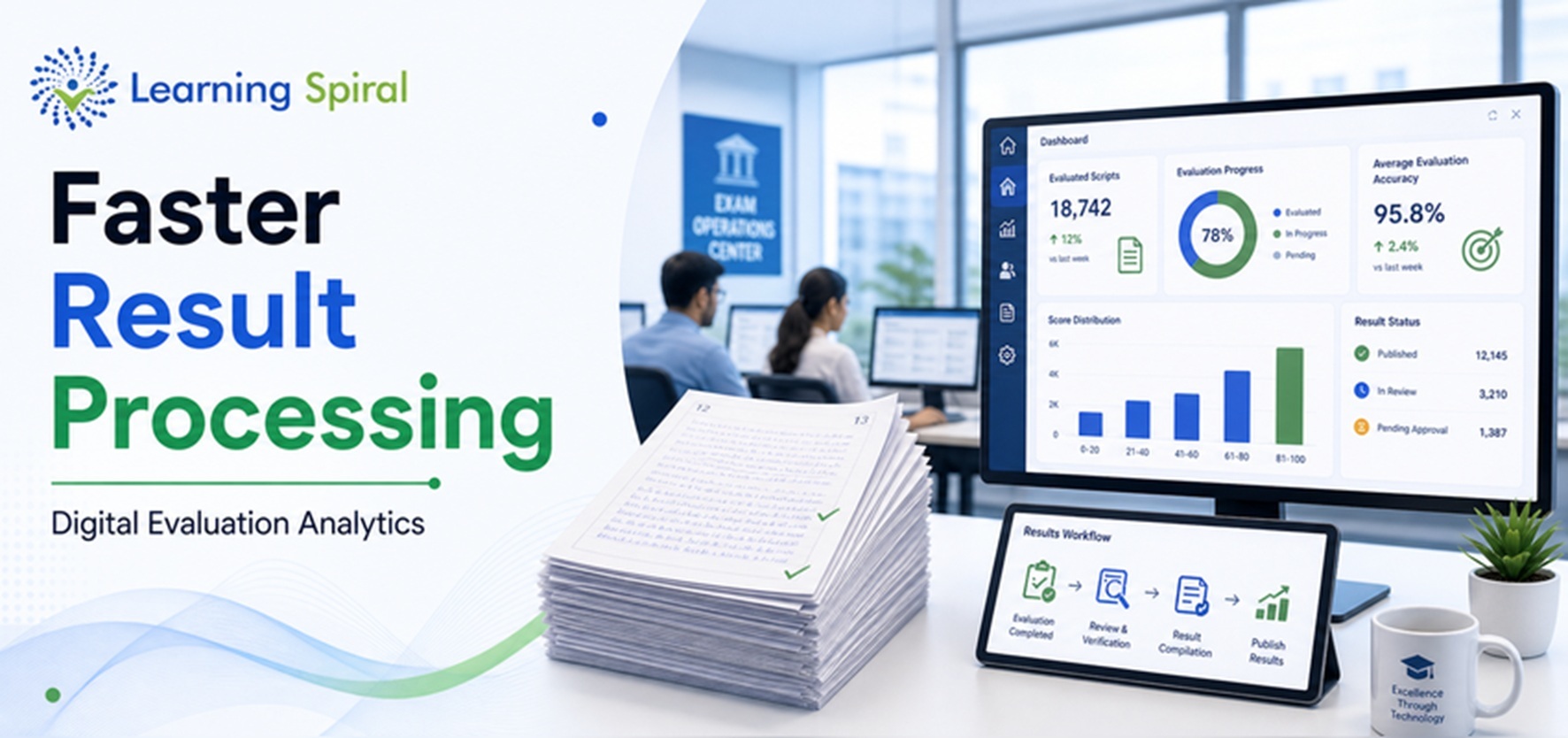
The final examination may be over, but for a university examination department, some of the most critical work is only beginning.
Thousands of answer booklets must be collected, reconciled, scanned or physically distributed, assigned to evaluators, assessed, moderated, compiled and verified before a single final result can be published.
When these activities depend heavily on physical movement, spreadsheets, manual marks entry and repeated reconciliation, even a small delay at one stage can affect the entire result declaration timeline.
That is why Post Examination Processing has become one of the most important areas for digital transformation in higher education.
By connecting Answer booklet scanning, On Screen Evaluation, marks processing and analytics within a structured workflow, universities can move from “examination completed” to “result ready” with greater visibility, accuracy and operational control.
The transformation, however, is not simply about replacing paper with screens.
It is about building a connected examination workflow in which every stage supports the next.
What Is Post Examination Processing?
Post Examination Processing refers to the academic and administrative activities that take place after an examination has been conducted and before—and sometimes after—the final results are declared.
Depending on institutional policies, it can include:
• Collection and reconciliation of answer booklets
• Answer booklet scanning and digitisation
• Allocation of scripts to evaluators
• On Screen Marking
• Moderation and review
• Marks compilation
• Internal and external marks integration
• Grace-mark or moderation-rule processing
• Grade and result calculation
• Result verification and approval
• Result publication
• Mark sheet generation
• Scrutiny and revaluation
• Academic performance analytics
• Examination reporting and archival
A modern approach connects these activities rather than managing them through disconnected systems.
This is where Digital Evaluation becomes especially important.
Physical answer scripts can be converted into digital records, securely allocated to evaluators and assessed through controlled digital workflows. Evaluated marks can then move into downstream result-processing activities without unnecessary repetition of manual work.
Why Traditional Post-Exam Workflows Slow Down Results
Result preparation rarely depends on one department or one process.
A university may be simultaneously coordinating examination centres, scanning teams, evaluators, moderators, academic departments, examination administrators and IT teams.
In a traditional workflow, each hand-off can create another potential bottleneck.
For example:
1. Physical answer booklet movement takes time.
Booklets may need to travel from examination centres to collection hubs and then to evaluators.
2. Evaluator allocation requires coordination.
Physical bundles must be assigned, dispatched, monitored and collected.
3. Manual marks entry creates repetitive work.
Marks written on answer scripts may later need to be entered again into another application or spreadsheet.
4. Evaluation progress can be difficult to monitor.
Administrators may depend on calls, messages or manual reports to determine how much evaluation is still pending.
5. Moderation adds another round of movement.
Scripts selected for review may need to be physically transferred again.
6. Result preparation requires reconciliation.
Internal marks, external marks, practical assessments and other examination records must be combined accurately.
Digitisation addresses these problems most effectively when the entire workflow is connected.
1. Answer Booklet Scanning Creates the Digital Starting Point
For handwritten examinations, the journey toward faster results often begins with Answer booklet scanning.
Through systematic Scanning of Answer Sheets, physical scripts can be converted into secure digital copies for subsequent evaluation.
But university-level scanning should involve more than simply feeding paper into a scanner.
A reliable workflow may include:
• Packet and booklet reconciliation
• Barcode or QR-based mapping
• Page sequence checking
• Image-quality verification
• Missing-page identification
• Supplementary-sheet mapping
• Candidate identity masking
• Exception handling
• Secure storage
• Audit logging
If an answer booklet has a missing page, incorrect mapping or unreadable image, problems can continue throughout evaluation.
Therefore, scanning quality becomes one of the foundations of an effective Digital Evaluation System.
Once scripts have been verified and digitised, physical distribution is no longer required for every evaluator. Digital scripts can move through the system without moving the original answer booklet repeatedly.
2. On-Screen Evaluation Makes Script Allocation Faster
One of the biggest operational changes occurs when universities shift from physical bundle allocation to On-Screen Evaluation.
On Screen Evaluation, also written as On-Screen Evaluation, enables authorised examiners to evaluate scanned answer scripts digitally.
Instead of waiting for physical answer-booklet bundles, evaluators can receive authorised digital scripts through an On Screen Evaluation System.
This can simplify several activities.
• Scripts can be allocated according to subject and evaluator rules.
• Candidate identities can be masked where institutional policy requires it.
• Evaluation progress can be monitored centrally.
• Pending scripts can be identified quickly.
• Selected scripts can be routed for moderation or review.
• Digital records of evaluation activity can be maintained.
This is especially useful when universities are working with large numbers of evaluators across different locations.
The administrative question changes from:
“Where is this bundle of answer scripts?”
to:
“What is the current evaluation status of this script?”
That difference can have a significant impact on operational visibility.
3. On-Screen Marking Reduces Repetitive Manual Work
On Screen Marking or On-Screen Marking is the evaluator-facing component of digital evaluation.
Through an On Screen Marking System or On-Screen Marking System, examiners can view responses and allocate marks digitally.
Depending on institutional requirements, the system may support features such as:
• Question-wise marks entry
• Maximum-mark validation
• Annotation or highlighting tools
• Evaluator allocation controls
• Script navigation
• Moderation workflows
• Progress tracking
• Digital audit trails
The biggest operational advantage is not simply that marking happens on a computer.
It is what happens to the marks afterwards.
When marks are captured digitally during evaluation, universities can reduce the need to copy the same information from paper into spreadsheets and then into another examination application.
Every avoided manual re-entry reduces another opportunity for mismatch or delay.
4. Digital Evaluation Connects Marking Directly with Result Processing
In a fragmented workflow, evaluation and result processing can feel like two completely different projects.
Evaluators finish checking papers.
Then another team begins collecting, entering, checking and processing marks.
A connected Digital Evaluation System can create a much smoother transition.
Once marking and authorised review are complete, validated marks can move toward result-processing workflows according to the university’s academic rules.
This matters because the purpose of educational assessment extends beyond simply producing a number. Assessment records ultimately support academic decisions, progression, feedback and institutional understanding of learner performance.
Digital evaluation can therefore connect several processes that were traditionally separated:
Answer Booklet Scanning → On Screen Evaluation → On Screen Marking → Moderation → Marks Processing → Result Verification → Result Publication
This continuity can substantially simplify Post Examination Processing.
5. Automated Validation Can Reduce Result-Processing Bottlenecks
Faster evaluation alone does not guarantee faster results.
The resulting marks still have to be checked and processed according to institutional rules.
A structured University Examination System may help universities automate or systematise checks such as:
• Whether every expected mark has been received
• Whether marks exceed configured maximum values
• Whether any scripts remain unevaluated
• Whether moderation cases remain pending
• Whether internal and external marks are available
• Whether practical marks have been received
• Whether required approvals have been completed
• Whether result-processing rules have been applied
Instead of discovering incomplete records near the final publication stage, examination teams can identify exceptions earlier.
This changes Post Examination Processing from a large final reconciliation exercise into a more continuously monitored workflow.
6. Analytics Turn Examination Data into Actionable Insight
Publishing the result should not be the end of the examination-data journey.
A digital workflow creates structured information that can be analysed across subjects, programmes, cohorts and assessment cycles.
This is where examination analytics can add another layer of value.
Universities may analyse:
• Subject-wise performance
• Pass and failure patterns
• Grade distributions
• Question-wise performance
• Programme-level trends
• Evaluation turnaround time
• Evaluator progress
• Moderation patterns
• Revaluation trends
• Assessment performance across semesters
The broader field of learning analytics explores how educational data can be analysed to generate insights that support learning and institutional decision-making.
Within examination administration, analytics can help institutions move beyond asking:
“How quickly did we declare the results?”
toward asking:
“What can examination data tell us about assessment quality, learner performance and future academic planning?”
Analytics can therefore turn Post Examination Processing from an administrative endpoint into an institutional intelligence opportunity.
7. A Connected Examination Ecosystem Accelerates the Entire Cycle
Post-examination efficiency cannot be viewed in isolation.
A mistake made before an examination can create additional work after it.
Incorrect student-subject mapping, incomplete eligibility records or inconsistent examination data can later affect script mapping, marks compilation and result preparation.
That is why Pre Examination Processing, examination administration and Post Examination Processing should ideally operate as connected stages.
A modern examination journey can look like this:
Student & Academic Data → Pre Examination Processing → Question Bank Management → Examination Delivery → Answer Booklet Scanning → On Screen Evaluation → Digital Evaluation → Result Processing → Analytics
For digital examinations, the process can also connect through an Online Examination System and Online Assessment workflow.
This means universities do not necessarily need to choose between paper and digital examination models.
A connected University Examination System can support different assessment formats while bringing their downstream academic records into a structured ecosystem.
Digital Evaluation and Analytics: Why the Combination Matters
Digital Evaluation improves the way answer scripts move through the evaluation process.
Analytics improves the way institutions understand what happened during that process.
Together, they can provide university examination teams with two forms of visibility.
Operational visibility answers questions such as:
• How many scripts have been scanned?
• How many have been evaluated?
• Which subjects are still pending?
• Which evaluators have outstanding scripts?
• Which cases require moderation?
• Is marks processing complete?
Academic visibility can help answer:
• Which subjects have unusual performance patterns?
• Which assessments generated high failure rates?
• How do results differ across programmes or examination cycles?
• Which areas may require deeper academic review?
A mature digital examination environment needs both.
Speed without visibility can create risk.
Analytics without reliable underlying data can create misleading conclusions.
Connected Digital Evaluation and Post Examination Processing create the foundation for both.
Where a University Management System Fits
A University Management System contains much of the academic context required during Examination Processing.
Student enrolment, programmes, semesters, subjects, examination eligibility, internal assessments and academic records are all connected to the result a student ultimately receives.
When examination systems operate completely separately from these records, staff may repeatedly export, import and reconcile data.
Integration helps create a smoother information journey.
A connected University Examination System can therefore act as the examination layer within the wider university technology ecosystem.
The objective is not merely software integration.
It is to prevent examination staff from becoming the manual bridge between multiple disconnected databases.
What Universities Should Look for in Post-Examination Technology
Before adopting an Online Exam Solution, On Screen Evaluation System or Digital Evaluation platform, universities should evaluate the complete workflow—not only the evaluator interface.
Key questions include:
1. Can the platform manage peak examination volumes?
The system should be designed around actual institutional scale.
2. How is Answer booklet scanning controlled?
Image quality, mapping, missing pages and exceptions need defined processes.
3. How are scripts allocated and monitored?
Administrators need clear visibility over evaluation progress.
4. How does the On Screen Marking System enforce evaluation rules?
Marking workflows should align with university policies.
5. What happens after evaluation?
Validated marks should integrate efficiently with Post Examination Processing.
6. How are moderation, scrutiny and revaluation handled?
The examination lifecycle continues after the first round of marking.
7. What analytics and reports are available?
Dashboards should turn operational and assessment data into useful information.
8. Can the platform connect with existing university systems?
A new digital platform should reduce fragmentation rather than create another isolated data silo.
From Faster Evaluation to Faster Results
The largest improvement in result turnaround does not necessarily come from making one activity dramatically faster.
It comes from removing delays between activities.
Scanning should connect to evaluation.
Evaluation should connect to moderation.
Moderation should connect to marks processing.
Marks processing should connect to result verification.
Results should connect to analytics and academic records.
When these stages operate as a continuous digital workflow, Post Examination Processing becomes easier to monitor, scale and manage.
That is the real value of Digital Evaluation.
It does not simply digitise marking.
It creates a structured path from the final submitted answer booklet to the final approved result.
Frequently Asked Questions
What is Post Examination Processing?
Post Examination Processing covers activities performed after an examination, including answer-script handling, Digital Evaluation, marks compilation, moderation, result calculation, verification, publication, revaluation and examination reporting.
How does Digital Evaluation help universities publish results faster?
Digital Evaluation reduces physical movement of answer scripts, enables digital evaluator allocation and marking, provides central progress visibility and can reduce repetitive manual marks entry before result processing.
What is On Screen Evaluation?
On Screen Evaluation or On-Screen Evaluation is a process in which authorised evaluators assess digitised copies of answer scripts through a secure digital interface instead of marking physical booklets.
What is the difference between On Screen Marking and Digital Evaluation?
On Screen Marking mainly refers to evaluators viewing and marking digital scripts. Digital Evaluation can describe the wider workflow involving Answer booklet scanning, script allocation, marking, monitoring, moderation and downstream marks processing.
Why is Answer Booklet Scanning important?
Answer Booklet Scanning converts physical answer scripts into digital records. Accurate scanning and mapping are essential because the resulting images become the scripts used for On-Screen Evaluation.
Can handwritten examinations use a Digital Evaluation System?
Yes. Students can continue writing examinations on physical answer booklets. The scripts can then be scanned, verified and evaluated digitally using an On Screen Evaluation System.
How can analytics improve Post Examination Processing?
Analytics can provide visibility into evaluation progress, subject performance, grade distributions, turnaround times, moderation patterns and other examination trends, supporting administrative and academic decision-making.
Can an Online Examination System connect with Post Examination Processing?
Yes. A connected Online Examination System can feed assessment records into downstream evaluation, marks processing, result generation and reporting workflows depending on the institution’s technology architecture.
Ready to Accelerate Your Result Processing?
If your institution still relies on physical answer-script movement, manual evaluator tracking, repetitive marks entry or disconnected result-processing systems, it may be time to redesign the workflow.
Learning Spiral Ltd. can help you explore a more connected approach to Digital Evaluation, On Screen Evaluation, Examination Processing and Post Examination Processing.