A university examination may last three hours for a student. For the university, however, the process can begin weeks before the examination and continue until results, revaluation and final academic records are completed.
Student registration. Subject mapping. Question paper preparation. Hall tickets. Examination schedules. Answer scripts. Evaluation. Moderation. Marks processing. Results.
When each activity runs through a different spreadsheet, portal, email trail or physical workflow, even a small operational gap can create delays across the entire examination cycle.
That is why the future of the University Management System is not simply about putting administrative records online.
The next generation of university technology will connect the complete examination journey—from Pre Examination Processing and secure question creation to Online Assessment, Answer booklet scanning, On Screen Evaluation, marks processing and final result publication.
The goal is simple: fewer disconnected processes, fewer manual handovers and a much more transparent examination ecosystem.
Why Traditional University Management Systems Are Reaching Their Limit
Many institutions have already digitised individual university processes. Yet digitisation alone does not guarantee integration.
A university may have:
- An ERP for student records.
- Another application for examination forms.
- A separate platform for question papers.
- Spreadsheets for evaluator allocation.
- Physical workflows for answer scripts.
- Another system for marks and result processing.
Each solution may perform its own function correctly, but the university still spends time transferring information between systems.
This is where a modern University Examination System needs to evolve.
The future is an interconnected examination architecture in which academic data can move securely from one stage to the next without repeated manual entry.
Here are seven major changes shaping that future.
1. Examination Processing Will Become One Connected Workflow
The biggest transformation will be the movement from fragmented applications to end-to-end Examination Processing.
Instead of treating every stage as a separate operation, a modern platform connects them as parts of one academic workflow.
A seamless examination lifecycle can include:
- Student and course data validation.
- Examination form processing.
- Subject and paper mapping.
- Hall ticket generation.
- Examination scheduling.
- Secure question paper management.
- Examination administration.
- Answer-script processing.
- Evaluation and moderation.
- Marks compilation.
- Result processing.
- Revaluation and grievance management.
This connected approach reduces repetitive data entry and makes it easier for Controllers of Examinations, administrators and authorised users to understand exactly where an examination cycle stands.
More importantly, information generated during Pre Examination Processing can move directly into examination-day and Post Examination Processing activities.
The university no longer has to recreate the same data at every stage.
2. Question Papers Will Move From Files to Controlled Digital Workflows
Question paper creation is one of the most confidential elements of university examinations.
Email attachments, locally stored documents, shared folders and manual coordination between faculty members create operational complexity.
A modern Question Bank Management system changes the process by bringing question creation, review, moderation and generation into a structured environment.
Universities can build a central question repository where questions can be organised using criteria such as:
- Subject and syllabus unit.
- Question type.
- Difficulty level.
- Marks or weightage.
- Learning objective.
- Previous usage.
- Author or moderator.
- Approval status.
A more intelligent Question Bank Management workflow can also help authorised teams generate balanced papers while maintaining tighter control over access.
The future of examination security therefore begins much earlier than the actual examination day.
It begins when the first question is created.
3. Online Examination Systems Will Become Part of the University Core
Earlier, universities often treated online examinations as an additional technology used only for selected entrance tests, recruitment examinations or remote assessments.
That distinction is disappearing.
A modern Online Examination System can become an integrated component of the wider university technology ecosystem.
The student information already available within the University Management System can support registration, eligibility, course mapping and examination access without creating isolated databases for every assessment.
An effective Online Exam Solution can then support different assessment requirements, including:
- Semester assessments.
- Entrance examinations.
- Internal assessments.
- Practice examinations.
- Recruitment-style assessments.
- Objective and subjective examinations.
- Remote or centre-based examinations.
The real value does not come simply from moving a question paper onto a computer.
It comes from integrating Online Assessment with the surrounding examination workflow.
For additional background, Online Assessment broadly covers the use of digital technology to administer and support assessment activities.
This is why future examination platforms will need to connect assessment delivery with candidate data, question banks, security, evaluation and results.
4. Paper Answer Scripts Will No Longer Mean Paper-Based Evaluation
Universities do not necessarily need to eliminate handwritten examinations to achieve digital transformation.
Students can continue writing answers on physical answer booklets while the evaluation process becomes digital.
The bridge between those two environments is Answer booklet scanning.
After the examination, scripts can be digitised through controlled Scanning of Answer Sheets workflows.
The scanned answer scripts can then be mapped to the correct examination records and securely made available for digital evaluation.
This creates an important distinction:
Digitising the examination does not always mean changing how students write the examination.
It can simply mean changing how the university manages everything that happens after the student submits the script.
5. On-Screen Evaluation Will Turn Marking Into a Trackable Process
Once answer scripts have been digitised, universities can move from physical script distribution to On Screen Evaluation.
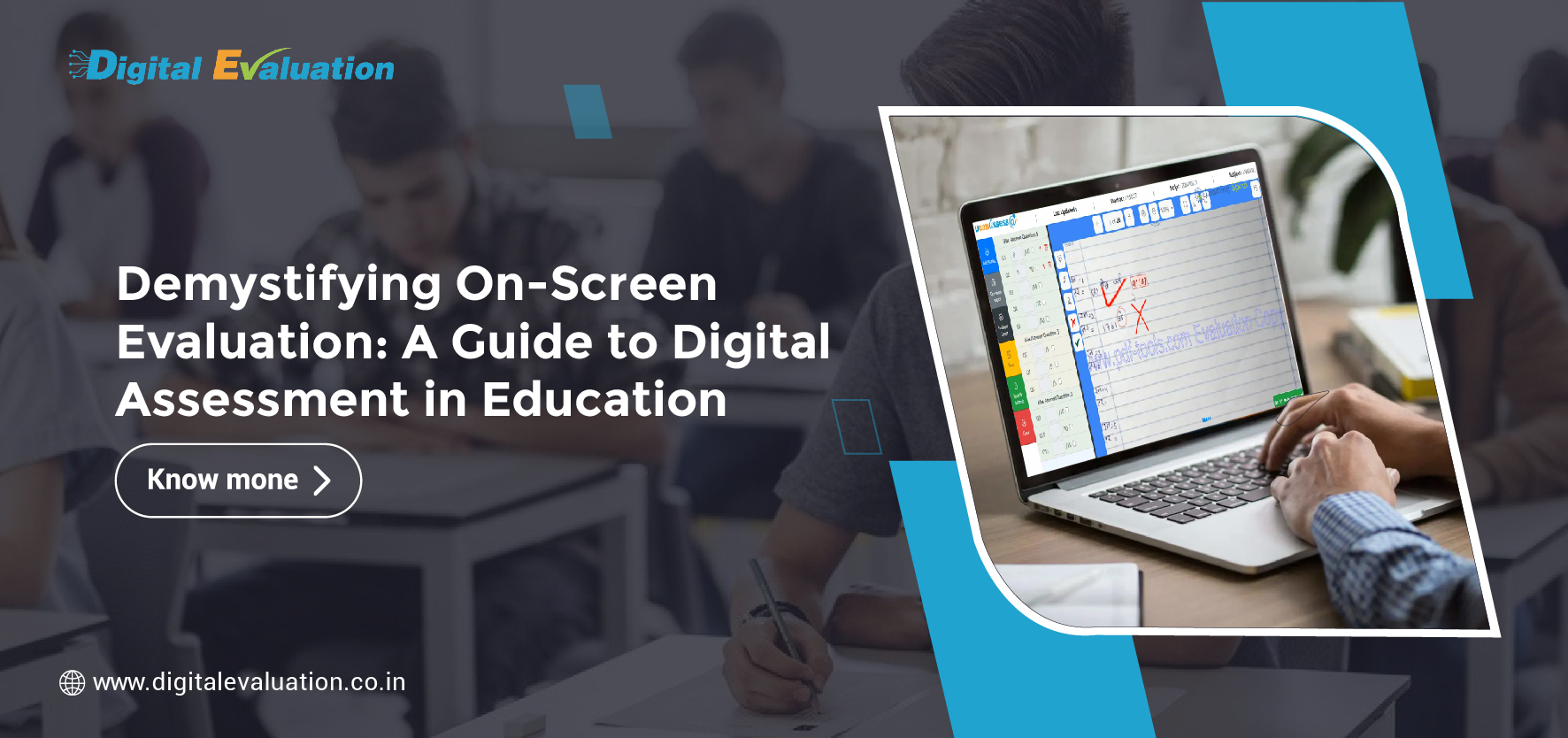
On-Screen Evaluation allows authorised evaluators to access scanned answer scripts digitally and record marks through a controlled evaluation interface.
It is also commonly described as On Screen Marking or On-Screen Marking.
A robust On Screen Marking System can help examination teams manage areas such as:
- Script allocation.
- Evaluator access.
- Digital annotations.
- Question-wise marking.
- Totalling controls.
- Moderation.
- Review and approval.
- Evaluation progress.
- Audit records.
An On-Screen Marking System therefore does more than replace a red pen with a computer.
It creates visibility around the complete evaluation workflow.
Similarly, an On Screen Evaluation System can allow examination administrators to monitor how scripts progress through evaluation instead of relying entirely on physical movement and manual follow-ups.
Users also search for the technology using variations such as On- Screen Evaluation System, but the underlying objective remains the same: make subjective evaluation more controlled, measurable and auditable.
6. Digital Evaluation Will Connect Directly With Result Processing
A major limitation of disconnected evaluation systems is what happens after marking is complete.
If marks need to be manually exported, re-entered or reconciled in another system, the university introduces another opportunity for delays and discrepancies.
A future-ready Digital Evaluation System should connect evaluation directly with marks processing.
Through Digital Evaluation, scanned scripts and evaluator activity can become part of a structured digital academic workflow.
Once evaluation and required approvals are completed, marks can move forward for:
- Validation.
- Moderation.
- Compilation.
- Result calculation.
- Result approval.
- Publication.
- Revaluation, wherever applicable.
This makes Post Examination Processing an extension of evaluation rather than an entirely separate administrative exercise.
The result is a smoother path from the evaluator’s screen to the student’s result.
7. The Future University Management System Will Be Modular, Connected and Data-Driven
Universities are complex organisations.
Trying to force admissions, examinations, academics, finance, HR, student services and evaluation into one rigid application can make future upgrades difficult.
The emerging model is more flexible.
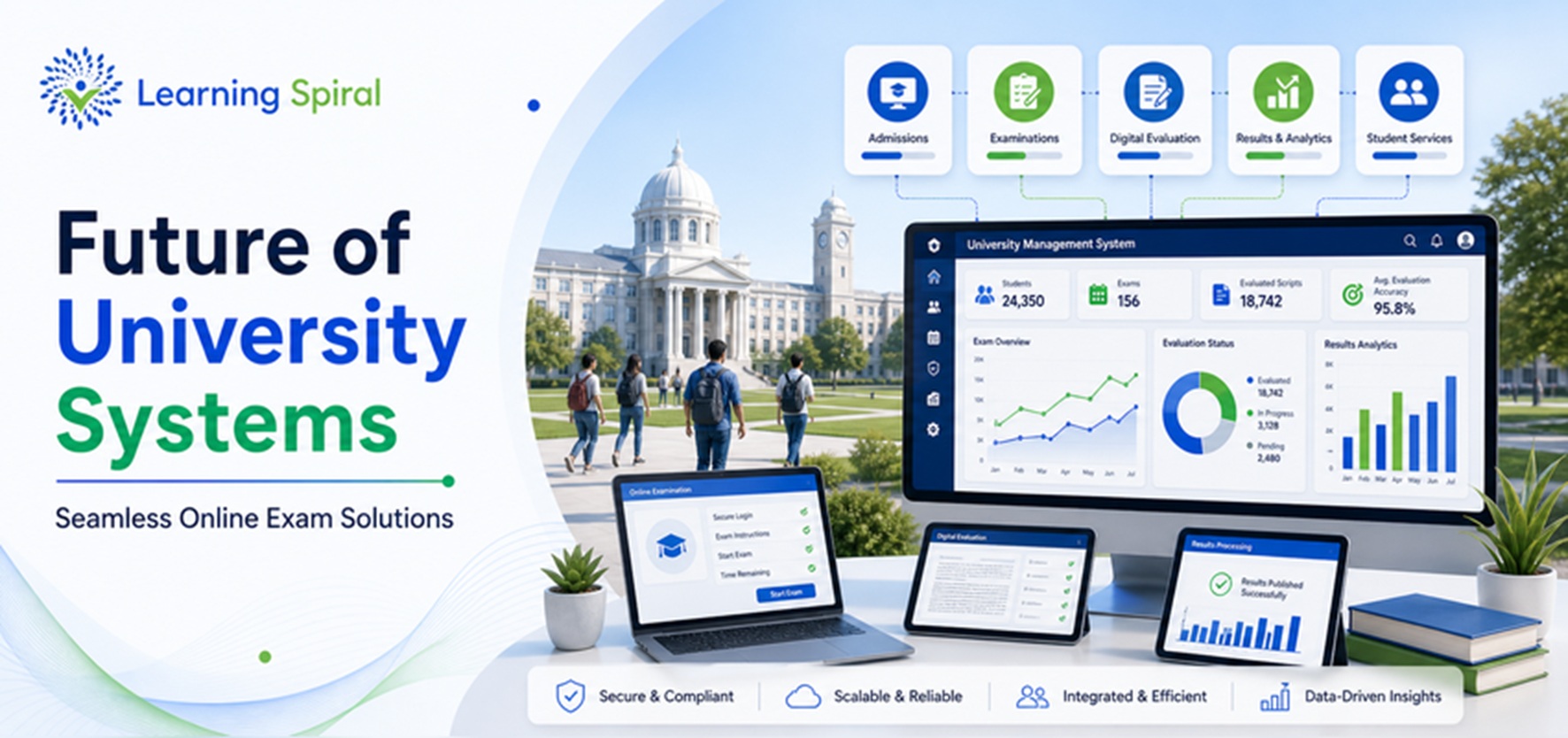
A modern University Management System can provide the institutional backbone while specialised applications handle functions such as online examinations, question banks, scanning, digital evaluation and results.
These systems can exchange information through secure interrogations.
This allows universities to modernise individual processes without rebuilding their entire technology environment whenever a requirement changes.
The future architecture will increasingly prioritise:
- Interoperability.
- Secure APIs.
- Role-based access.
- Configurable workflows.
- Audit trails.
- Scalable infrastructure.
- Real-time dashboards.
- Data security.
- Automation.
- Better institutional analytics.
The objective is not to create the biggest software platform.
It is to create the most connected university ecosystem.
What Does a Truly Seamless Online Exam Solution Look Like?
For a Controller of Examinations, Registrar or university technology leader, the most important question is not how many features a platform contains.
The better question is:
How many manual handovers can it remove from the examination lifecycle?
A seamless workflow could look like this:
- Student records are validated inside the university system.
- Pre Examination Processing manages eligibility, examination forms, subjects, schedules and hall tickets.
- Question Bank Management handles question creation, moderation and secure paper preparation.
- The Online Examination System manages applicable computer-based examinations and assessments.
- For handwritten examinations, Scanning of Answer Sheets converts physical answer scripts into securely manageable digital copies.
- The On Screen Evaluation System distributes those scripts to authorised evaluators.
- The Digital Evaluation System manages marking, review, moderation and finalisation.
- Post Examination Processing uses approved marks for result calculation, publication and downstream academic records.
What appears to students as a simple examination is actually a sophisticated chain of operations.
The future belongs to platforms capable of connecting that chain.
What Universities Gain From Connected Examination Technology
When examination technology is treated as an ecosystem rather than a collection of isolated applications, several operational improvements become possible.
For Examination Departments
- Better visibility into examination progress.
- Less dependency on physical handovers.
- Reduced repetitive administrative work.
- Easier monitoring of evaluation.
- Faster access to examination data.
For Evaluators
- Secure digital access to allocated scripts.
- Structured marking workflows.
- Reduced physical movement of answer booklets.
- Easier question-wise marking and review.
For University Leadership
- Better operational visibility.
- Stronger auditability.
- More reliable institutional data.
- Easier identification of bottlenecks.
- Better planning for future examination cycles.
For Students
The technology largely operates behind the scenes, but students experience its outcomes through smoother examination services, improved visibility and more efficient result workflows.
What Should Universities Look for Before Choosing an Online Exam Solution?
A long feature list should not be the only deciding factor.
Universities should evaluate whether the platform can work within their actual examination environment.
Before selecting an Online Exam Solution, consider these questions:
- Can it integrate with existing student and academic systems?
- Does it support both online and traditional handwritten examination models?
- Can Question Bank Management, examination delivery and evaluation work as connected workflows?
- Does the system provide role-based access and detailed audit trails?
- Can it handle Answer booklet scanning at the institution’s required scale?
- Does the On Screen Marking System support monitoring, moderation and review?
- Can marks move into Post Examination Processing without repeated manual entry?
- Can workflows be configured according to university rules rather than forcing the university to change its academic processes?
These questions help distinguish a standalone examination application from a genuine University Examination System.
The Bigger Shift: From Digital Tools to Digital University Operations
The next phase of university digital transformation will not be defined by how many applications an institution deploys.
It will be defined by how effectively those applications work together.
A connected examination ecosystem allows the university to move from:
- Manual follow-ups to workflow visibility.
- Physical answer-script movement to digital allocation.
- Isolated marking to On-Screen Evaluation.
- Repetitive marks entry to integrated Digital Evaluation.
- Separate exam tools to an end-to-end University Examination System.
That is the real future of university technology.
How Learning Spiral Ltd. Helps Build the Connected Examination Lifecycle
Learning Spiral Ltd. helps universities and examination bodies digitise critical assessment and examination workflows across the examination lifecycle.
From Question Bank Management and Online Assessment to Answer booklet scanning, On Screen Marking, Digital Evaluation System, Pre Examination Processing and Post Examination Processing, the focus is on reducing operational complexity while improving control and visibility.
Instead of treating every stage as an isolated activity, institutions can move towards a connected environment in which data travels securely through the examination lifecycle.
For universities planning their next phase of digital transformation, that integration can be far more valuable than adding another standalone application.
Conclusion: The Future Is Not Just Online—It Is Connected
The future University Management System will not simply store more information.
It will connect people, processes and specialised technologies across the academic lifecycle.
For university examinations, that means connecting:
Student Data → Pre Examination Processing → Question Bank Management → Examination Delivery → Answer Booklet Scanning → On Screen Evaluation → Digital Evaluation → Post Examination Processing → Results
When these stages work together, examination management becomes easier to monitor, easier to scale and more responsive to institutional needs.
Universities do not need more disconnected technology.
They need an examination ecosystem in which every process knows what comes next.
And that is where the next generation of university management begins.
Frequently Asked Questions
1. What is a University Management System?
A University Management System is a digital platform or connected technology environment used to manage university processes such as student records, academics, examinations, administrative workflows and related institutional activities.
2. How does an Online Examination System integrate with a University Management System?
An Online Examination System can exchange student, course, eligibility and examination information with the wider university system, reducing the need to recreate examination data manually.
3. What is On Screen Evaluation?
On Screen Evaluation or On-Screen Evaluation is a digital marking process in which authorised evaluators evaluate scanned answer scripts through an electronic evaluation platform rather than physically handling paper scripts.
4. What is the difference between On Screen Marking and Digital Evaluation?
On Screen Marking primarily refers to evaluators marking scripts digitally. Digital Evaluation can cover the wider workflow, including scanning, script allocation, marking, moderation, monitoring, approval and marks processing.
5. Why is Answer booklet scanning important?
Answer booklet scanning transforms physical scripts into digital copies that can be securely allocated and evaluated through an On Screen Evaluation System.
6. What does Post Examination Processing include?
Post Examination Processing can include marks compilation, moderation, result calculation, result publication, revaluation and other activities performed after the examination.
7. Can universities combine handwritten examinations with Digital Evaluation?
Yes. Students can continue writing physical answer booklets. The scripts can then undergo Scanning of Answer Sheets and be evaluated digitally through an On Screen Marking System.
8. What makes an Online Exam Solution future-ready?
A future-ready Online Exam Solution should integrate securely with existing university systems, support scalable examination workflows, provide auditability and connect assessment data with evaluation and result-processing activities.