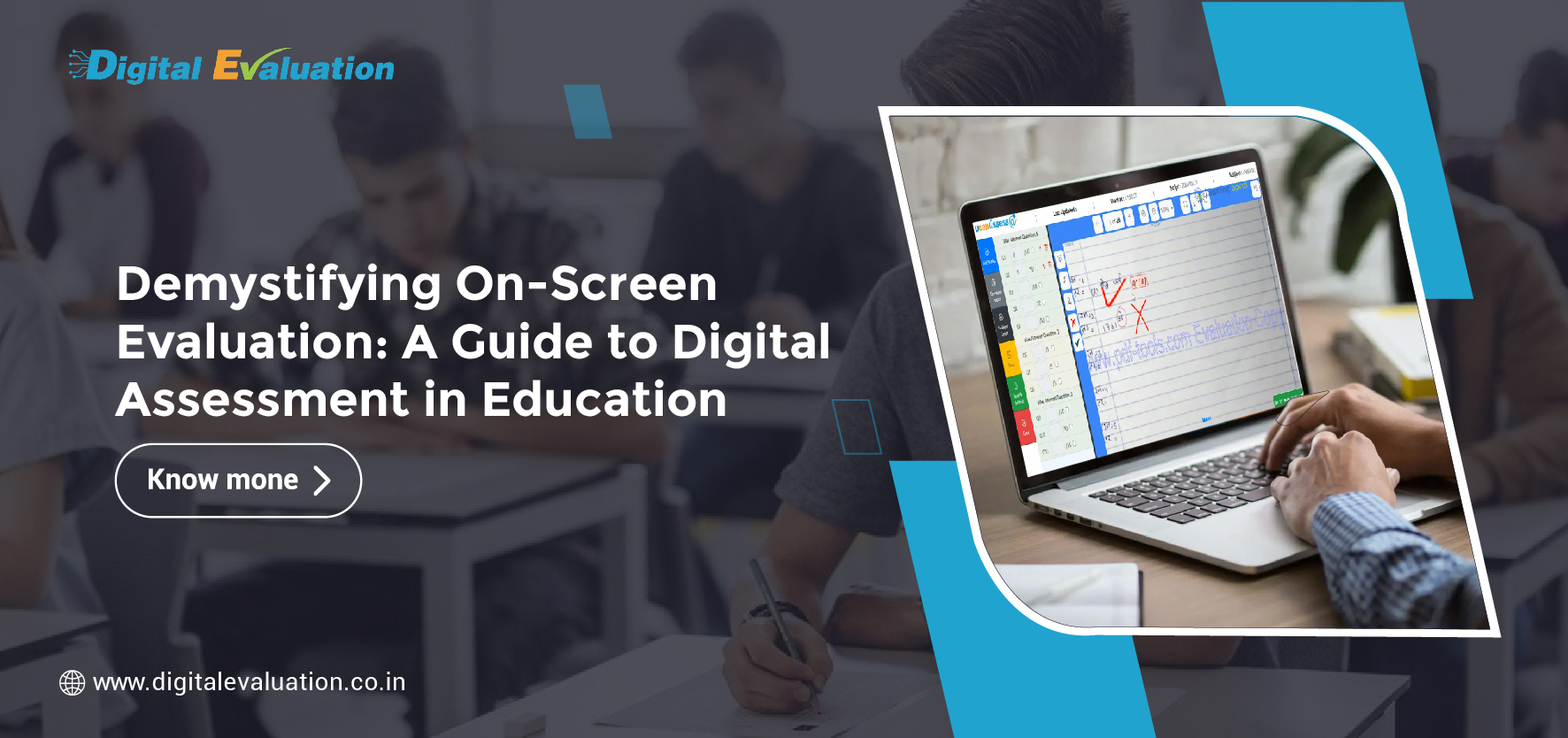
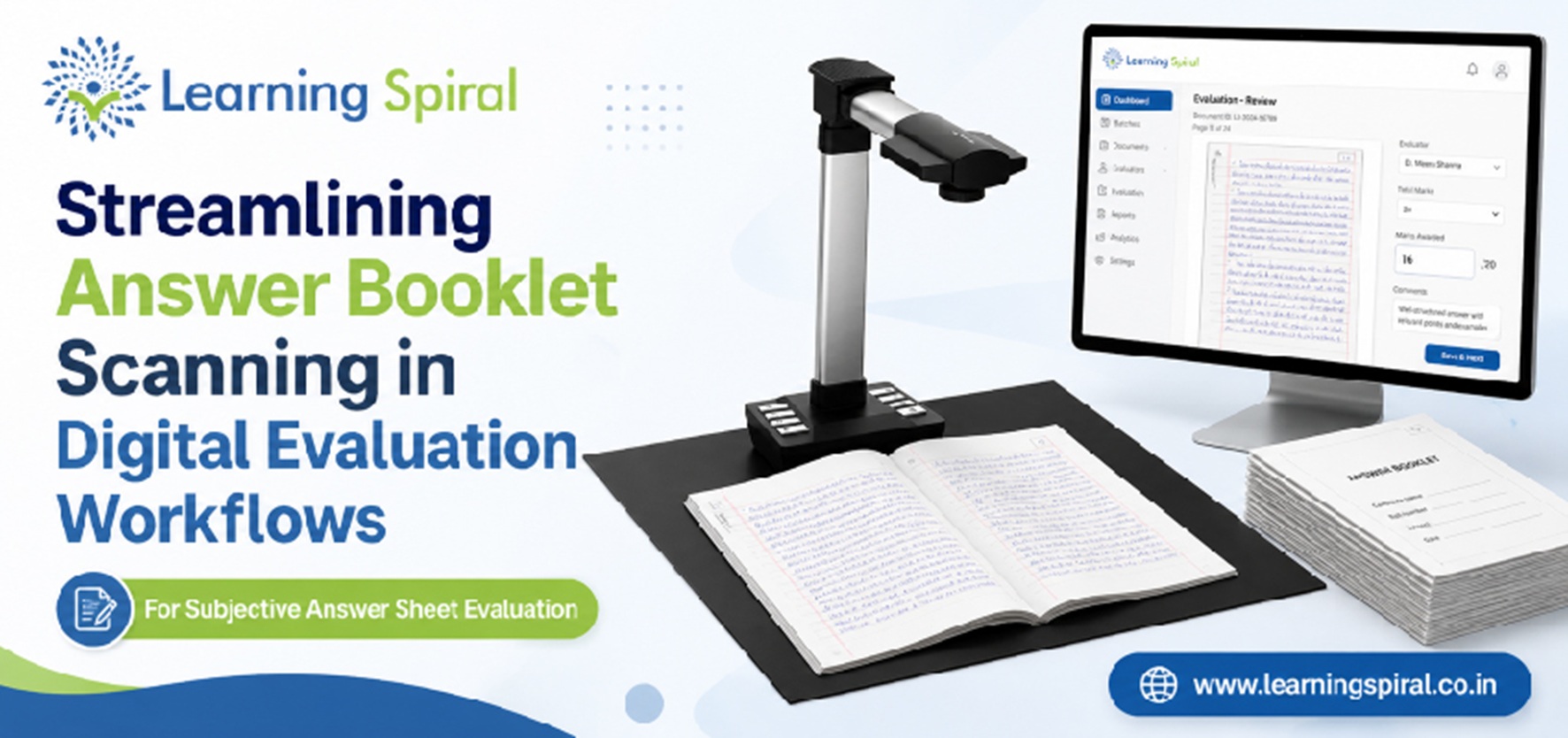
What if the biggest delay in university result processing begins before an examiner evaluates a single answer?
Every examination cycle generates thousands of handwritten answer booklets that must be collected, identified, scanned, verified, and assigned to evaluators. When these activities depend heavily on manual coordination, even a small scanning error can create delays across the entire evaluation process.
A missing page, an incorrectly mapped answer script, or an unclear scanned image can interrupt the examination workflow and increase the administrative workload.
This is where Answer Booklet Scanning becomes a critical component of modern Digital Evaluation.
By combining structured scanning procedures, automated quality checks, secure script management, and integrated evaluation technology, universities can create a more efficient and transparent process.
Let’s explore seven practical ways institutions can streamline answer booklet scanning and establish reliable evaluation workflows.
Why Answer Booklet Scanning Matters in Digital Evaluation
The journey from handwritten answer sheets to digitally processed results involves much more than converting paper documents into images.
An effective scanning workflow ensures that every answer booklet is captured accurately, assigned to the correct examination, and made available to authorized evaluators.
Within a modern Digital Evaluation System, this process supports secure script allocation, on-screen assessment, moderation, marks compilation, and result publication.
Without reliable scanning, universities may encounter missing pages, incorrect booklet sequences, duplicate records, or unnecessary delays.
Accurate scanning creates a dependable starting point for the entire evaluation process.
1. Standardize Answer Booklet Collection and Preparation
Efficient scanning starts before a document reaches the scanner.
Universities should establish a consistent procedure for collecting answer booklets, validating examination details, checking page sequences, and preparing documents for digitization.
Standardized booklet formats can simplify the scanning process. Clearly printed identification codes, properly numbered pages, and consistent paper arrangements help reduce unnecessary manual intervention.
A well-organized collection and preparation workflow also supports accountability by helping examination authorities track the movement of answer scripts.
By reducing variations at the collection stage, institutions can make subsequent scanning activities more predictable and easier to manage.
2. Improve Accuracy with High-Speed Scanning and Quality Control
High-volume examinations demand scanning processes that can handle large numbers of answer sheets without compromising readability.
High-speed document scanners can accelerate image capture, while automated quality checks can help identify blurred pages, skewed images, incorrect orientation, and incomplete scans.
A reliable Scanning of Answer Sheets workflow should maintain readability and preserve the completeness of handwritten responses, including diagrams, formulas, and supplementary sheets.
Image enhancement and document-processing technologies can support this process by improving visibility and helping operators identify problematic scans.
For example, Optical Character Recognition can be useful for reading selected printed identifiers or structured information, although handwritten academic responses still require appropriate evaluation and verification.
Importantly, scanning quality should be measured through both image clarity and document completeness.
The objective is not simply to scan answer sheets quickly. It is to ensure that every digitized script is ready for meaningful academic evaluation.
3. Automate Script Identification and Digital Indexing
Imagine a university processing thousands of answer booklets across multiple examination centers, courses, and subjects.
Manually identifying and organizing every scanned script creates opportunities for administrative mistakes.
Barcode-based identification, QR codes, and structured metadata can help institutions associate scanned answer booklets with their corresponding examination records.
This approach can streamline script identification and reduce repetitive data-entry tasks.
Digital indexing also enables examination administrators to organize scripts according to subject, course, examination session, and other approved identifiers.
When integrated with a University Examination System, these processes create a more structured connection between examination records and digitized scripts.
Accurate indexing helps ensure that the correct answer booklets reach the appropriate evaluation workflows while maintaining necessary confidentiality controls.
4. Integrate Scanning with On-Screen Evaluation
Scanning delivers its greatest value when digitized answer scripts move smoothly into the evaluation platform.
A disconnected scanning process may require additional file transfers, manual allocation, and repeated verification.
An integrated workflow connects scanning, script identification, evaluator allocation, marking, and monitoring.
With a modern On Screen Evaluation System, authorized evaluators can access assigned digital answer scripts without depending on the physical transportation of examination booklets.
Using an On-Screen Marking workflow, evaluators can review responses digitally, record marks, and follow institution-defined evaluation instructions.
For universities, this creates opportunities to reduce physical handling and improve visibility into evaluation progress.
For evaluators, it provides a structured digital environment for reviewing answer scripts.
When scanning and marking operate as connected stages, institutions can manage the evaluation cycle with greater consistency.
5. Strengthen Data Security and Examination Confidentiality
Examination answer scripts contain sensitive academic information that requires controlled access throughout the evaluation lifecycle.
A secure Digital Evaluation System should include appropriate safeguards for document handling, user authentication, data storage, and access permissions.
Student identity masking, where required by institutional policy, can support confidentiality during evaluation.
Role-based access controls can help ensure that evaluators, moderators, and administrators access only the information necessary for their responsibilities.
Encryption, activity logs, and controlled script allocation can provide additional protection.
The broader principles of Document Processing demonstrate why structured digitization must involve more than image capture. Document content, organization, storage, and interpretation all require careful management.
For examination authorities, security should remain a continuous priority, from the initial scanning stage to final result publication.
6. Connect Scanning with Pre- and Post-Examination Processing
An examination management system becomes more effective when individual activities work together instead of operating in isolation.
Before examinations, universities manage candidate information, subject registration, scheduling, question paper preparation, and examination-center coordination.
Solutions for Question Bank Management can support structured question creation, review, approval, and secure question paper preparation.
After the examination, Answer Booklet Scanning creates digital records that can move into On Screen Marking, moderation, verification, and marks compilation.
During Post Examination Processing, these records can support result calculation, reporting, review processes, and publication.
An integrated Online Exam Solution may also connect these workflows with an Online Examination System and Online Assessment capabilities.
This allows institutions to support both handwritten examinations and digitally delivered assessments within a broader examination ecosystem.
The result is a more connected University Management System in which examination administrators have better visibility across the academic assessment lifecycle.
7. Monitor Scanning Performance and Resolve Exceptions Early
Universities cannot improve processes they do not measure.
An efficient scanning operation should provide administrators with meaningful information about throughput, pending workloads, image-quality issues, and script verification.
Rather than waiting until evaluators report missing or unclear pages, institutions can identify scanning exceptions earlier in the workflow.
Important operational indicators include the number of booklets scanned, the percentage requiring rescanning, unresolved identification issues, and the time needed to make verified scripts available for evaluation.
These insights allow examination teams to identify bottlenecks and allocate resources more effectively.
A connected University Examination System can support broader coordination between examination preparation, evaluation, and result-related activities.
Early exception handling contributes to a more reliable Examination Processing workflow and helps institutions protect important academic timelines.
How Streamlined Scanning Benefits Universities and Examination Boards
Modernizing answer booklet scanning can create practical improvements throughout university examination administration.
Faster evaluation readiness: Efficient document preparation and scanning help institutions make verified digital scripts available to evaluators sooner.
Better operational accuracy: Quality-control procedures can identify missing, unclear, or incorrectly mapped pages before they affect marking.
Reduced physical handling: Digital script distribution can minimize the movement of physical answer booklets between evaluation locations.
Improved examination visibility: Administrators can monitor scanning progress, evaluator workloads, and pending examination activities through connected systems.
Stronger accountability: Structured digital records and activity tracking can simplify verification, moderation, and review processes.
Scalable examination operations: A well-designed scanning and evaluation workflow can be adapted to different examination volumes, academic calendars, and institutional requirements.
These benefits become more meaningful when scanning is treated as an essential part of the overall On-Screen Evaluation process rather than an isolated administrative activity.
How Learning Spiral Ltd. Simplifies Answer Booklet Scanning and Digital Evaluation
Learning Spiral Ltd. supports universities, examination boards, and higher-education institutions through technology-driven examination and assessment solutions.
Its UCanEvaluate solution brings together important stages of subjective-answer evaluation, including script scanning, secure allocation, on-screen viewing, digital marks capture, moderation, reporting, and result-related processing.
The platform supports both destructive and non-destructive scanning approaches, high-speed scanning workflows, student identity masking, controlled evaluator allocation, and structured marks processing.
Learning Spiral’s wider examination technology offerings also cover Pre Examination Processing, Question Bank Management, Online Examination System, Online Assessment, and Post Examination Processing.
By connecting these processes, institutions can reduce dependence on fragmented workflows and build a more coordinated examination environment.
Whether an institution is modernizing traditional handwritten examinations or expanding its digital assessment infrastructure, Learning Spiral helps create structured solutions aligned with operational requirements.
The Future of Answer Booklet Scanning Is Connected, Secure, and Intelligent
As universities manage increasingly complex examination schedules and higher volumes of academic records, scanning workflows must evolve beyond basic document digitization.
The next stage of improvement involves better automation, stronger quality assurance, integrated reporting, and more effective exception management.
AI-assisted document processing may help identify scanning anomalies, support document classification, and reduce repetitive verification activities. However, institutional controls and human oversight remain essential, particularly when academic records or evaluation decisions are involved.
A modern On Screen Marking System works best when every preceding activity, from booklet preparation to digital verification, is dependable.
For universities, the priority should be to create an examination environment where technology supports examiners, protects academic records, and simplifies administrative responsibilities.
Conclusion: Build a Smarter Evaluation Journey from the First Scan
A faster result declaration begins with a more reliable answer booklet scanning process.
By standardizing document handling, introducing quality checks, improving digital indexing, strengthening security, and integrating scanning with On Screen Evaluation, universities can create more transparent and efficient examination workflows.
The real transformation happens when scanning, marking, moderation, and result processing work as parts of one connected system.
Learning Spiral Ltd. helps educational institutions move toward this integrated approach through scalable examination technology and digital evaluation solutions.
Connect with Learning Spiral Ltd. to explore a digital evaluation workflow tailored to your institution.
Frequently Asked Questions
What is Answer Booklet Scanning in Digital Evaluation?
Answer booklet scanning is the process of converting handwritten examination answer scripts into digital images that can be securely stored, verified, allocated, and evaluated through a digital platform.
How does Answer Booklet Scanning improve On Screen Evaluation?
It helps create clear, organized, and verified digital answer scripts that evaluators can access electronically, reducing dependence on physical booklet distribution and enabling more structured evaluation.
What is the difference between On-Screen Marking and Digital Evaluation?
On-Screen Marking refers specifically to recording marks while reviewing answers digitally. Digital Evaluation covers the broader workflow, including scanning, evaluator allocation, marking, moderation, reporting, and result processing.
Can universities integrate scanning with an existing examination system?
Yes. Depending on the platform’s integration capabilities, scanning workflows can be connected with examination databases, subject information, evaluator management, and result-processing systems.
How can universities prevent scanning errors?
Institutions can implement standardized booklet preparation, image-quality checks, page-count validation, script identification, exception reporting, and manual review procedures for problematic documents.
How does Learning Spiral Ltd. support university digital evaluation?
Learning Spiral Ltd. provides examination technology solutions, including UCanEvaluate, which supports answer-script scanning, secure evaluator allocation, on-screen evaluation, marks processing, reporting, and related examination workflows.