For students, an examination may begin when the question paper reaches their desk and end when they submit their answer booklet.
For a university, the examination cycle begins much earlier—and continues long after the final answer script is collected.
Student registration, subject mapping, examination scheduling, question paper preparation, centre allocation, answer-script tracking, evaluation, moderation, marks processing, revaluation and final result publication are all connected parts of one larger process.
The challenge arises when these activities operate independently.
A spreadsheet may contain student data. Another system may manage question papers. Physical answer booklets may move between examination centres and evaluators. Marks may then be entered manually into yet another application before results are processed.
Every disconnected handoff creates another opportunity for delay, duplication and administrative effort.
A modern University Examination System changes this approach by connecting Pre Examination Processing, examination delivery, evaluation and Post Examination Processing into a structured digital workflow.
The objective is not simply to digitise individual examination activities. It is to create an examination ecosystem in which data can move securely and systematically from one stage to the next.
What Is an Integrated University Examination System?
A University Examination System is a technology-driven platform designed to coordinate the complete examination lifecycle—from planning and preparation before the examination to evaluation, marks processing and result publication afterward.
Instead of treating each examination activity as an isolated task, an integrated system creates continuity between departments, academic rules, student records and examination data.
This becomes particularly important for universities managing multiple colleges, courses, semesters, subjects and large student populations.
Modern examination environments may combine an Online Examination System, physical examinations, digital answer-script processing and Online Assessment depending on institutional requirements.
The value comes from connecting these activities rather than managing them through independent workflows.
Why Pre and Post Examination Processing Should Not Operate Separately
Many examination delays are not caused by one major failure.
They are caused by dozens of small administrative handoffs.
A student record entered incorrectly during registration can affect hall-ticket generation. Incorrect subject mapping can create complications during answer-script allocation. Delayed scanning can slow evaluation. Missing marks can hold up an entire result-processing cycle.
When pre-exam and post-exam activities operate independently, examination departments often spend significant time reconciling information between systems.
An integrated Examination Processing model reduces this fragmentation.
The same structured data used during registration and examination planning can support later activities such as answer-script identification, evaluator allocation, marks consolidation and result generation.
That creates an important principle for universities:
The quality of post-examination processing often depends on how well the pre-examination process was structured.
1. Pre Examination Processing: Building the Foundation
Pre Examination Processing includes the administrative and academic activities required before an examination can be conducted successfully.
It is the foundation of the complete University Examination System.
Typical pre-examination activities may include:
• Student and examination registration – Identifying eligible candidates and mapping them with the correct programmes, semesters and subjects.
• Subject and course mapping – Connecting examination papers with academic structures and student registrations.
• Examination scheduling – Creating dates, sessions, centres and examination timetables while reducing scheduling conflicts.
• Candidate eligibility verification – Applying institutional rules before candidates are permitted to appear.
• Roll number and centre allocation – Assigning students systematically to examination centres and sessions.
• Admit card generation – Producing examination credentials using verified student and examination data.
• Question paper preparation – Creating and approving examination papers securely before distribution.
• Attendance and examination documentation – Preparing candidate lists, attendance sheets and related examination records.
When these activities are digitised within a structured University Management System, examination departments can reduce repeated manual data entry and maintain stronger continuity across the examination cycle.
2. Question Bank Management: Where Examination Quality Begins
Question paper preparation is one of the most sensitive pre-examination activities.
Traditional workflows may involve documents moving through email, spreadsheets, shared folders or multiple faculty members. This can create difficulties around version control, confidentiality and tracking.
A structured Question Bank Management system allows institutions to create, categorise, review and securely store questions within a central repository.
Questions may be classified using parameters such as:
• Subject
• Unit or module
• Difficulty level
• Marks
• Question type
• Learning outcome
• Topic
• Academic programme
A digital question bank can also support controlled question paper generation and role-based access.
This helps transform question-paper preparation from a document-management activity into a structured academic workflow.
3. Conducting the Examination
Once pre-examination processing is complete, the institution enters the examination-delivery stage.
Depending on the university, examinations may be conducted through traditional pen-and-paper methods, computer-based examinations or a hybrid approach.
For digitally conducted assessments, an Online Exam Solution can support candidate authentication, question delivery, response capture, examination security and monitoring.
For traditional written examinations, the focus shifts toward correctly identifying, collecting and tracking answer booklets after the examination.
This is where the transition between examination delivery and evaluation becomes particularly important.
4. Answer Booklet Scanning: Creating the Digital Bridge
In a paper-based examination, physical answer scripts must eventually enter the evaluation workflow.
Answer booklet scanning creates the bridge between traditional written examinations and digital evaluation.
Instead of physically transporting answer scripts repeatedly between locations and evaluators, institutions can digitise them after collection.
The Scanning of Answer Sheets can create secure digital copies that can be indexed, tracked and assigned electronically to authorised evaluators.
A controlled scanning workflow may include:
• Answer booklet receipt and tracking
• Barcode or identifier validation
• Page-level scanning
• Image-quality checks
• Script indexing
• Candidate identity masking where required
• Digital script storage
• Allocation to evaluators
Accurate scanning is critical because every later evaluation activity depends on the readability and completeness of the digitised script.
5. On-Screen Evaluation: Moving Evaluation Beyond Physical Scripts
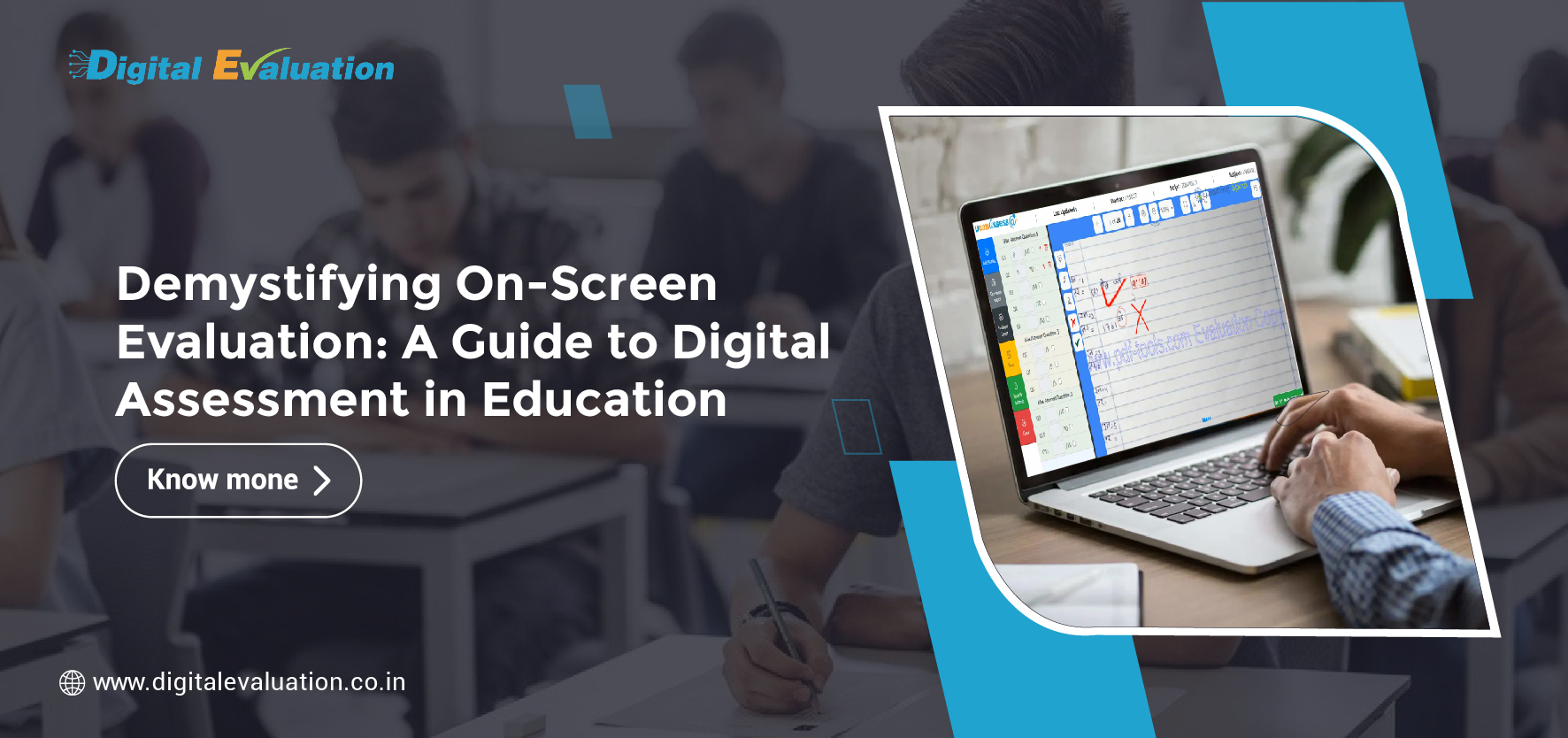
After answer scripts are digitised, universities can move into On-Screen Evaluation.
An On Screen Evaluation System enables authorised evaluators to access digital answer scripts through a controlled interface instead of receiving physical bundles.
This can reduce the physical movement of answer booklets while providing better visibility into evaluation progress.
Depending on institutional rules and platform capabilities, an On Screen Marking System may support features such as:
• Secure evaluator login
• Digital answer-script allocation
• Question-wise marking
• Annotation tools
• Marks validation
• Evaluation-progress monitoring
• Moderation workflows
• Audit trails
• Automatic marks consolidation
On Screen Marking also helps universities build a more traceable evaluation environment because evaluation activity can be monitored through system records rather than physical movement alone.
The shift from paper handling to On-Screen Marking is therefore not merely a change in where evaluators see answer scripts. It changes how evaluation is tracked and controlled.
6. Digital Evaluation as Part of the Complete Examination Workflow
A Digital Evaluation workflow becomes much more valuable when it is connected with the broader examination system rather than deployed as an isolated marking application.
Learning Spiral’s wider examination technology work spans admissions, examinations, assessments, digital evaluation and result processing across educational institutions. Its 25-year milestone and work with more than 2,000 institutions have also been highlighted in recent media coverage.
Within an integrated Digital Evaluation System, marks generated during evaluation can flow toward moderation and result processing without requiring repeated manual transcription.
This reduces an important risk in traditional workflows: marks being correctly awarded by the evaluator but incorrectly copied, transferred or consolidated later.
Digital integration therefore improves more than evaluation speed.
It improves continuity of examination data.
7. Post Examination Processing: Where Evaluation Becomes a Result
Finishing evaluation does not mean the examination process is complete.
Universities still need to verify marks, apply academic rules, process moderation, manage withheld cases, calculate grades and prepare final results.
This phase is known as Post Examination Processing.
Typical activities may include:
• Marks consolidation
• Missing-marks verification
• Moderation
• Grace-mark rules
• Internal and external marks integration
• Grade calculation
• Result validation
• Result publication
• Revaluation or scrutiny processing
• Mark-sheet generation
• Academic reporting
When these activities depend on manually transferred spreadsheets or disconnected software, examination departments may need repeated rounds of reconciliation.
A connected University Examination System can move verified evaluation data directly into downstream result-processing workflows.
8. Why Integration Matters More Than Individual Automation
A university may already use technology for several examination activities.
It may have online registration.
It may have question-generation software.
It may use scanning equipment.
It may even operate a Digital Evaluation System.
But having multiple digital tools does not automatically create an integrated examination process.
The larger benefit comes when systems communicate with each other.
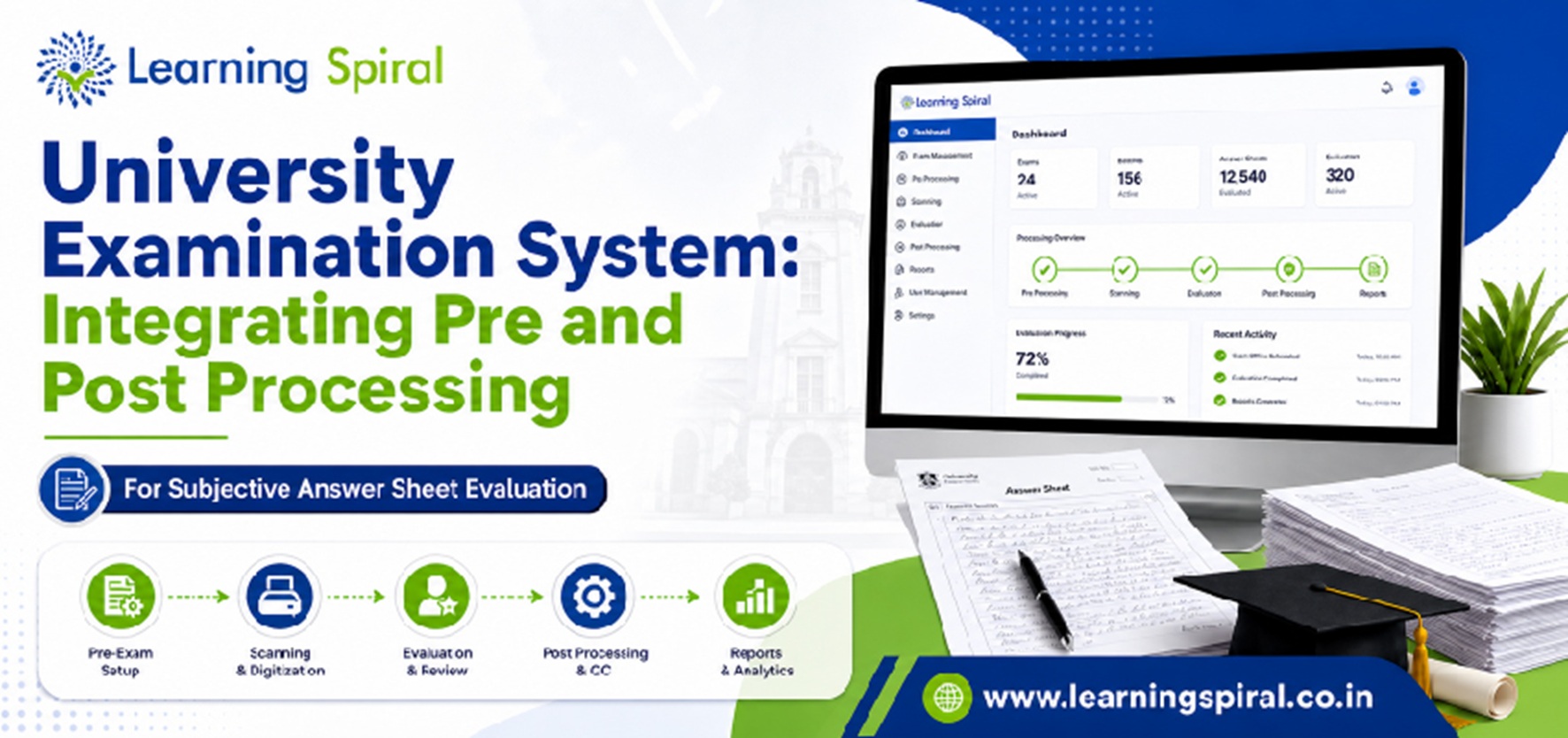
Consider this sequence:
1. Candidate records are verified during registration.
2. Subjects are mapped before the examination.
3. Question papers are prepared through secure Question Bank Management.
4. Candidates write examinations.
5. Answer booklets are scanned and indexed against examination data.
6. Digital scripts are allocated through an On Screen Evaluation System.
7. Evaluators complete On-Screen Marking.
8. Verified marks move into Post Examination Processing.
9. Academic rules are applied.
10. Results and academic records are generated.
When these stages operate as one workflow, data does not need to be repeatedly recreated at every stage.
That is the difference between digitising examination tasks and digitally transforming examination processing.
9. Key Benefits of Integrating Pre and Post Processing
1. Faster Examination Workflows
Connecting systems reduces delays created by physical movement, repeated data entry and manual reconciliation.
This can help examination departments move more efficiently from registration to result declaration.
2. Improved Data Accuracy
Every manual transfer creates another opportunity for error.
Integrated workflows allow verified information to move between examination stages more consistently.
3. Greater Examination Security
Role-based access, controlled workflows, audit records and digital tracking can strengthen examination confidentiality and accountability.
4. Better Evaluation Visibility
With Digital Evaluation and On-Screen Evaluation, administrators can monitor evaluation progress and identify pending work more easily than with physical answer-script bundles.
5. Reduced Administrative Workload
Automation allows examination teams to spend less time coordinating repetitive operational tasks.
6. Stronger Auditability
Digital records can help institutions understand who performed specific activities and when they were completed.
7. Better Student Experience
Efficient Examination Processing can ultimately support more predictable result declaration, fewer administrative errors and faster resolution of examination-related issues.
10. Connecting Online and Offline Examination Models
Not every university needs to move every examination online.
An integrated University Examination System can support different examination models.
A university may continue conducting written examinations while using Answer booklet scanning, Digital Evaluation and Post Examination Processing.
Another institution may use a fully digital Online Examination System.
Others may operate both models depending on programme, examination type and regulatory requirements.
That flexibility is important because digital transformation should adapt to institutional requirements rather than force every university into the same examination model.
Digital Evaluation and digital assessment technologies should therefore be viewed as components within a larger examination ecosystem.
11. Common Problems Universities Should Avoid
Technology alone will not solve every examination challenge.
Universities should avoid several common mistakes during implementation.
• Mistake 1: Digitising Only One Stage
Installing an evaluation platform while keeping everything before and after it manual can limit the benefits.
Better approach: Map the complete examination lifecycle before selecting technology.
• Mistake 2: Repeated Manual Data Entry
Entering the same student, subject or marks information into several systems increases risk.
Better approach: Establish structured data exchange between examination stages.
• Mistake 3: Ignoring Answer-Script Tracking
Digital evaluation depends on accurate script identification.
Better approach: Build traceability into collection, scanning, indexing and evaluation.
• Mistake 4: Treating Result Processing as an Afterthought
Evaluation speed matters only if the university can efficiently convert evaluated marks into verified results.
Better approach: Connect evaluation with Post Examination Processing from the beginning.
• Mistake 5: Selecting Software Without Understanding Existing Processes
Every university has different ordinances, academic structures and examination rules.
Better approach: Configure technology around institutional processes and compliance requirements.
12. What Should Universities Look for in a Modern Examination Platform?
Before selecting a University Examination System, institutions should evaluate whether the platform can support the complete examination journey.
Important capabilities include:
• Pre Examination Processing
• Candidate and subject management
• Secure Question Bank Management
• Question paper generation
• Examination scheduling
• Online and offline examination workflows
• Answer booklet scanning
• Scanning of Answer Sheets
• On Screen Evaluation
• On-Screen Evaluation
• On Screen Marking
• Moderation and evaluator management
• Marks consolidation
• Post Examination Processing
• Revaluation workflows
• Result generation
• Reporting and analytics
• Role-based access and auditability
• Integration with existing university systems
The strongest platform is not necessarily the one with the longest feature list.
It is the one that connects the university’s actual examination processes with the least unnecessary administrative friction.
Learning Spiral: Connecting the Complete Examination Lifecycle
Learning Spiral Ltd. works with universities, higher education institutions and examination bodies to address examination and assessment challenges through technology-driven solutions.
Its solutions cover areas including University Examination System workflows, Question Bank Management, Online Examination System, Answer Booklet Scanning, On-Screen Evaluation, Digital Evaluation and Post Examination Processing.
Learning Spiral states that it has more than 25 years of domain experience and works with universities and examination boards across India to improve examination efficiency, evaluation accuracy and result-processing workflows.
Rather than viewing examinations as separate pre-exam, evaluation and post-exam activities, the objective is to connect these stages into a continuous and manageable digital process.
Final Thoughts
A university examination does not begin with the first question and end with the last answer booklet.
It is a complete operational cycle.
The quality of that cycle depends on how effectively data, people and processes move between preparation, examination delivery, evaluation and result processing.
A modern University Examination System brings those stages together.
By connecting Pre Examination Processing, Question Bank Management, Answer booklet scanning, On Screen Evaluation, Digital Evaluation and Post Examination Processing, universities can reduce fragmented workflows and create a more transparent, traceable and efficient examination environment.
The future of examination management is therefore not about digitising one activity at a time.
It is about building a connected examination ecosystem in which every stage supports the next.
Frequently Asked Questions
1. What is a University Examination System?
A University Examination System is a digital platform or connected set of workflows used to manage examination activities such as candidate registration, question preparation, scheduling, examination delivery, answer-script processing, evaluation, marks management and result declaration.
2. What is Pre Examination Processing?
Pre Examination Processing covers activities completed before an examination, including registration, eligibility checking, subject mapping, examination scheduling, centre allocation, admit-card generation and question-paper preparation.
3. How does On-Screen Evaluation work?
In On-Screen Evaluation, physical answer booklets are scanned and converted into digital scripts. Authorised evaluators can then access and mark these scripts securely through an On Screen Marking System.
4. Why is Answer Booklet Scanning important?
Answer booklet scanning connects paper-based examinations with Digital Evaluation. Accurate scanning and indexing help institutions track scripts, provide secure evaluator access and reduce physical movement of answer booklets.
5. What is Post Examination Processing?
Post Examination Processing includes marks consolidation, moderation, application of academic rules, grade calculation, result validation, publication, revaluation and related academic reporting.
6. Can universities integrate paper examinations with Digital Evaluation?
Yes. Universities can continue conducting traditional written examinations while digitising answer scripts through Scanning of Answer Sheets and completing evaluation through an On Screen Evaluation System.
7. What is the advantage of integrating pre and post examination processing?
Integration reduces repeated data entry and disconnected workflows. It allows verified examination data to move systematically from registration and examination preparation through evaluation and final result processing.
Call to Action
Ready to Connect Your Complete Examination Workflow?
Transform fragmented examination operations into a connected digital ecosystem with Learning Spiral Ltd.
From Pre Examination Processing and Question Bank Management to Answer Booklet Scanning, On-Screen Evaluation, Digital Evaluation and Post Examination Processing, our solutions are designed to support universities and examination bodies across the complete assessment lifecycle.
Schedule a consultation and discover how your institution can build a faster, more secure and structured examination workflow.